A founder begins delaying decisions that once took minutes. A senior executive loses concentration, returns to questions that were supposedly settled and gradually becomes the point through which every exception must pass. A team that performed well for years grows irritable, cautious and strangely slow. From the outside, the diagnosis arrives quickly: burnout, declining motivation, insufficient resilience, weak leadership.
Any of those explanations may be correct. Beginning with them is still risky, because the same visible failure can emerge from entirely different mechanisms.
Five people can fail in the same position because five people share the same weakness. They can also fail because the position itself has become structurally impossible to operate. An executive may look indecisive after responsibility has expanded far beyond real authority. A founder may appear unable to delegate while remaining the only person who possesses enough fragmented context to resolve contradictions produced elsewhere in the organization. Exhaustion can be psychological, yet it can also be an accurate physiological response to a system that has turned permanent exception handling into a human job.
This distinction is where my Anti-Coaching methodology begins. Before attempting to improve the person, it examines the conditions under which that person is expected to function and asks what kind of system repeatedly produces the same pressure.
Pressure is information before it becomes a diagnosis
Contemporary management language moves easily from a visible symptom to an individual prescription. A person under pressure needs resilience. A confused team needs clarity. A hesitant leader needs confidence. An organization struggling with transformation needs a stronger change culture. The vocabulary is useful, although it becomes dangerous when naming the symptom begins to substitute for examining its origin.
Human performance sits inside an environment made of authority, incentives, information, dependencies, financial exposure, accumulated commitments and decisions made elsewhere. Pressure can originate anywhere inside this structure and surface later as a behavioral problem in one particular person. By the time it reaches that person, the mechanism producing it may be several organizational layers away.
Consider a senior manager accountable for an outcome that depends heavily on departments outside that manager’s authority. Expanding responsibility is administratively easy; actual control does not automatically expand with the job description. Information may arrive late, key resources may belong to somebody else, dependencies may remain unresolved and intervention may require negotiation through several chains of command. Eventually the manager carries the psychological consequences of a mismatch built into the organization.
Coaching may help that manager endure the situation more effectively. It cannot manufacture authority that does not exist, repair an information route or resolve a dependency controlled elsewhere.
The same distortion appears at the top. Seniority provides broader access to information while increasing the amount of information competing for attention. Reports compress reality before it reaches the decision-maker; advisers filter it again; metrics reveal what the organization has learned to measure, frequently with delay. The person formally possessing the greatest authority can therefore hold the widest theoretical view of the system while remaining surprisingly distant from the surfaces where a new failure first becomes visible.
Stable environments can absorb a considerable amount of this imperfection. Under prolonged pressure, the gaps become expensive. Anti-Coaching therefore begins by mapping them: where responsibility has outrun control, where decisions have no clear owner, where information reaches authority too late to remain useful, and where unresolved commitments continue consuming attention because nobody has formally decided whether to keep them, change them or end them.
These are operational questions, although their consequences appear in human behavior. That distinction matters because treating every visible consequence as a personal deficit can leave the mechanism producing it untouched.
Motivation can become expensive infrastructure
Motivation occupies an unusual position in management culture because it can temporarily compensate for almost anything. A motivated team tolerates unfinished processes, unclear roles and excessive workloads. Founders bridge missing systems with personal involvement. Strong managers absorb ambiguity before it reaches their people. During a genuine emergency, this capacity can keep an organization alive.
The problem emerges slowly when exceptional effort becomes an ordinary operating requirement. An organization that needs unusually motivated people to execute routine work has quietly incorporated emotional energy into its infrastructure.
Such arrangements can survive for months and sometimes for years. Ambitious or loyal people are remarkably effective at compensating for structural weakness, especially when they identify strongly with the mission. The deterioration is rarely dramatic at first. Attention becomes less reliable, minor mistakes increase, decisions accumulate and experienced employees begin carrying more invisible work than their formal roles indicate.
Eventually someone leaves. The replacement receives the same job title, access rights and process documentation, yet performance changes because the departing employee had been carrying dozens of informal compensations that the organization never recognized as part of the system.
Management may interpret the decline as a cultural problem and respond with another motivational initiative. The underlying mechanism remains intact, and the organization effectively refinances structural debt with another dose of attention, urgency, loyalty and endurance.
A more durable architecture lowers the emotional cost of ordinary execution. Sometimes this requires formal changes in decision rights or escalation thresholds. Elsewhere the intervention is almost embarrassingly mundane: one approval disappears, a recurring meeting loses its purpose, a predictable exception receives a rule, or a decision already made stops returning every three months because somebody finally records both the decision and the conditions under which it should be reconsidered.
These changes rarely look inspirational. They matter because they stop consuming expensive human judgment on problems the system can absorb itself.
The central question then shifts. Instead of asking how to keep people permanently energized, it becomes more useful to ask why normal operation requires extraordinary energy from them at all.
A temporary crisis can become the only operating model left
Crisis management contains a temporal assumption that is easy to miss. Something exceptional has happened; extraordinary measures are justified because normal conditions will eventually return.
Authority concentrates. Consultation contracts. Procurement accelerates. Maintenance is postponed. People accept workloads that would otherwise be unreasonable, and redundancy is consumed because immediate output matters more than preserving comfortable margins. During a short emergency, these choices can be entirely rational.
Their meaning changes when the emergency lasts for years.
Temporary roles harden into permanent ones while retaining emergency expectations. Exceptional workloads quietly lose their exceptional status. Strategic work is displaced again and again by whatever became urgent that morning. Maintenance debt accumulates in equipment, processes and people. The organization continues waiting for normality because its internal model still treats the environment as a deviation from an earlier baseline.
Eventually that baseline becomes historical.
Companies increasingly operate through overlapping technological disruption, geopolitical shocks, supply interruptions and financial uncertainty. Public institutions face security pressure while carrying administrative structures designed for slower environments. Entire organizations can spend years describing themselves as temporarily overloaded while the architecture created for the emergency becomes the only architecture they still possess.
At that point, endurance is no longer an adequate definition of resilience. The temporary system itself needs examination.
Some emergency procedures will have proved useful and deserve to remain. Others consume capabilities that are difficult to see because current output still looks acceptable. An experienced employee can carry three roles for a long time before departure reveals how much undocumented knowledge was concentrated in one person. Equipment can remain operational while accumulated maintenance reduces future readiness. A business can protect revenue through discounts, accelerated promises, executive intervention and delayed investment while steadily removing the conditions that made that revenue repeatable.
Current performance therefore tells only part of the story. A more revealing measure asks whether the same performance can be reproduced without consuming another layer of future capacity.
Adaptation has a budget
The contemporary response to instability is usually more adaptation. Organizations are told to become faster, flatter, more flexible and permanently ready to transform themselves as conditions change. The advice sounds self-evident partly because the cost of absorbing change rarely appears in the same sentence.
Every transformation creates a temporary loss somewhere inside the system. A new process requires learning before it produces fluency. Restructuring breaks part of the informal coordination that existed between people who already knew how to work together. New technology creates migration work, integration problems and unfamiliar failure modes before efficiency appears. A strategic pivot may be correct while simultaneously invalidating months of accumulated investment.
Those costs begin interacting as soon as several transformations run together.
A company replacing its technology stack while restructuring management, entering new markets, redesigning incentives and reducing headcount is not executing five isolated projects. Each transformation changes the operating conditions of the others. The new management structure has to learn a new technology while entering a new market with fewer people, and the original business continues running throughout the transition.
At some point, the organization begins spending more capacity adapting than performing the work that adaptation was intended to improve.
I describe this constraint as an Adaptation Budget: the finite amount of major change a system can absorb within a given period without unacceptable degradation. The number is contextual and changes with reserves, leadership, experience, financial position and the stability of the surrounding environment. Treating it as a universal formula would make the concept less useful. Its value lies in recognizing absorption capacity as a real operational constraint.
The principle becomes even more consequential inside public institutions. A government can possess the political authority and money required to launch several necessary reforms simultaneously while lacking the administrative capacity to implement them together. Procurement, training, legislation, institutional memory and public tolerance operate on different timelines. Conceptual correctness does not synchronize them.
This changes the transformation problem. Speed remains valuable, although sequencing becomes part of strategy and stability becomes a resource in its own right. Certain structures may need to remain deliberately untouched for a period simply because another part of the system is already consuming the available capacity for change.
An organization capable of changing everything is theoretically flexible. Operational maturity appears when it understands what it can afford to change now, what should wait and what must remain stable long enough for the rest of the system to catch up.
Decision architecture should eventually reduce the need for intervention
Anti-Coaching becomes practical when diagnosis changes architecture. The intervention may redistribute decision rights, define an escalation threshold, remove an approval whose original purpose disappeared years ago, create reserve capacity, distinguish reversible decisions from irreversible ones or expose a dependency that quietly became a single point of failure.
Organizations accumulate this invisible architecture for perfectly understandable reasons. A weekly meeting survives because nobody remembers the decision it once supported. A senior executive still approves a category of expenditure because of a failure that happened under a previous management team. Three departments maintain different reports because each inherited a separate historical definition of risk. Employees develop unofficial paths around these structures, and eventually the workaround carries more operational value than the formal process.
Consultants can easily make the environment heavier. New terminology arrives, followed by dashboards, workshops, reporting cycles and a methodology that requires constant interpretation. The organization becomes intellectually richer while accumulating another layer of operating weight.
For this reason, one of my criteria for a successful intervention is disappearance. As the architecture improves, the adviser should become less necessary and some of the machinery introduced during the intervention should disappear as well.
A useful change may cause several meetings to vanish because their function has been encoded elsewhere. Decisions that travelled upward for years may remain closer to the work once authority and thresholds become explicit. Senior leaders can stop carrying certain categories of uncertainty personally because the system has acquired a mechanism for containing them. Complexity does not disappear; less of it requires continuous human regulation.
An intervention that permanently needs its creator in order to remain intelligible has generated another dependency.
This principle does not imply that every organizational failure originates in architecture. People make bad decisions. Some leaders are incompetent, dishonest or destructive. Some founders refuse to delegate because they cannot tolerate losing control. A person can simply be unsuited to the responsibility that person carries, and a systems methodology should be capable of reaching that conclusion without hesitation.
What changes is the order of examination.
When the same failure appears across different people, when responsibility repeatedly exceeds control, when routine execution requires extraordinary effort, when emergency procedures remain in place for years, or when each transformation produces another transformation to repair its consequences, the surrounding system deserves scrutiny before another motivational explanation is applied.
The answer may still be the individual. At least the diagnosis has then survived contact with the environment in which that individual actually operates.
Organizations spend enormous amounts of human capacity compensating for structures they no longer notice. Over time, the compensation itself becomes normal. Exhaustion is read as weakness, hesitation as poor leadership, and refusal to absorb another transformation as resistance to change.
Sometimes those readings are accurate. In other situations, the behavior of the person is one of the few remaining surfaces through which the system can reveal its own condition.
Anti-Coaching begins by examining that signal before attempting to silence it.
For decades, we were told that globalization would connect the world, technology would improve it, and information would help us understand it.
Instead, we entered an era where every force claims to be holding the world together while pulling it in a different direction.
Governments compete for influence. Corporations compete for attention. Algorithms compete for our perception of reality. Entire economies react to headlines within seconds. Every crisis becomes global before anyone has time to understand it.
The world has not fallen apart.
It has become stretched.
We can see the tension everywhere. In politics that grows more polarized each year. In information systems that reward outrage over understanding. In a global economy where a decision made in one country immediately affects lives in another. In technologies advancing faster than societies can adapt to them.
Each force acts independently. Together, they place enormous pressure on the same fragile surface.
The danger is not necessarily collapse.
The danger is distortion.
Because distortion is harder to recognize. It happens gradually. We adapt to it. We normalize it. We convince ourselves that increasing instability is simply the new normal.
What makes this moment unique is that many of these pressures are applied in the name of stability itself.
Yet the more aggressively the world is managed, optimized, and reshaped, the more difficult it becomes to recognize the thing being protected.
We are witnessing a paradox of modern civilization:
The more pressure applied to preserve the world, the more distorted it becomes.
Perhaps this is the defining image of our time—not a world at war with itself, but a world being pulled simultaneously in every direction by those convinced they are saving it.
A global stress test with no clear endpoint.
And no agreement on how much tension the system can survive before something finally tears.
The Architecture of Pressure
Pressure is not always visible. Often, it appears through the systems designed to make life more predictable.
We construct institutions to manage uncertainty. We develop technologies to reduce friction. We create economic networks to distribute resources and political structures to establish order. Each system begins with a promise: greater efficiency, greater security, and greater connection.
Yet systems rarely operate independently.
A political decision can destabilize a market. A technological breakthrough can transform employment. An algorithm can influence public opinion, which subsequently influences political decisions. The result is not a single identifiable force but an accumulation of competing pressures.
The modern world resembles a structure whose individual components are being continuously adjusted without anyone fully understanding how those adjustments affect the whole.
This is particularly evident in our relationship with information.
Humanity has never possessed so many instruments for observing itself. We can witness conflicts, disasters, demonstrations, and political decisions almost immediately. We can measure public reactions, track economic movements, and compare events across continents.
But visibility does not necessarily produce understanding.
Information arrives faster than interpretation. Images circulate without context. Complex events are compressed into headlines, emotional reactions, and competing narratives. What should expand our perception can instead narrow it.
The paradox is that the more information becomes available, the more difficult it can become to distinguish the structure of reality from the systems that represent it.
We are connected, but connection does not guarantee coherence.
When Stability Becomes Distortion
Consider the language through which contemporary institutions justify their actions.
These words suggest preservation, yet the actions associated with them frequently involve transformation.
A government strengthens its borders to protect national stability. A corporation restructures its operations to preserve competitiveness. A digital platform modifies its algorithms to improve engagement or safety. Financial institutions intervene to prevent economic instability.
Each intervention may possess its own internal logic.
The difficulty emerges when these logics intersect.
One institution’s attempt to establish stability may introduce instability elsewhere. A solution for one population may create pressure for another. A technological improvement may solve an immediate problem while generating consequences that become visible only years later.
The world is not necessarily being destroyed by these interventions.
It is being continuously reshaped.
This distinction matters because destruction is comparatively easy to recognize. We can identify a collapsed building, a broken object, or a system that has ceased functioning.
Distortion is more ambiguous.
A distorted structure may remain operational. It may continue to perform its intended function while gradually losing the characteristics that originally defined it.
People adapt to these changes because adaptation is one of humanity’s fundamental survival mechanisms.
What was once exceptional becomes routine. What was once alarming becomes familiar. A condition initially described as temporary becomes part of the permanent environment.
We rarely experience this transformation as a single dramatic event.
Instead, we encounter it as a succession of adjustments.
And eventually, we may no longer remember the original shape.
The World as a Material
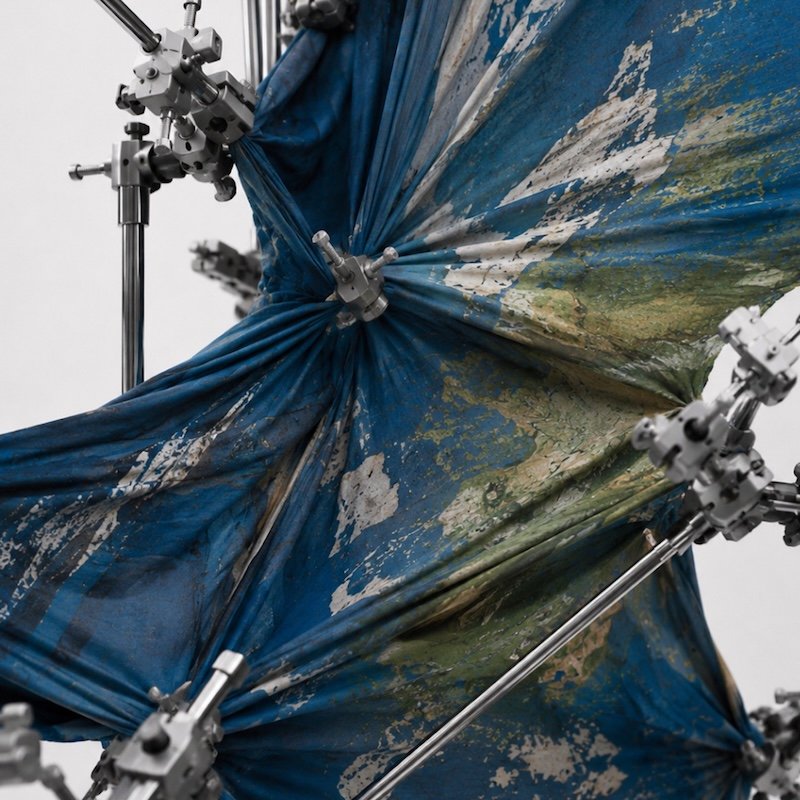
This contradiction became the starting point for my artistic project, World Stress Test.
I wanted to explore what would happen if the pressures shaping contemporary civilization could be translated into physical forces acting upon a recognizable image of the world.
Rather than representing globalization through familiar symbols of networks, borders or technological connectivity, I approached the world map as a material surface.
In the installation, a fabric carrying the image of the world is subjected to tension through a system of mechanical attachments, cables, and a suspended circular structure.
The material is pulled in different directions.
Its surface stretches. Its geography becomes unstable. Familiar continental forms are displaced by the forces acting upon them.
The map remains recognizable, but its proportions no longer obey the conventions through which we usually understand it.
This transformation is central to the work.
A conventional map promises orientation. It offers an apparently stable representation of territory, distance, and spatial relationships.
Yet a map is already an interpretation. It reduces the complexity of a planet into an organized image, selecting particular relationships while excluding others.
By physically deforming that image, the World Stress Test exposes the vulnerability of the representation itself.
The world has not disappeared.
But the instrument through which we recognize it has become unreliable.
The material resists the pressure imposed upon it. Its fibers respond differently across the surface. Tension accumulates around attachment points. Certain areas remain comparatively intact while others stretch or tear.
These differences cannot be entirely reduced to a predetermined image.
The behavior of the material becomes part of the artwork.
The Machinery of Preservation
The mechanical elements of the World Stress Test are not concealed.
The cables, clamps, and supporting structure remain visible.
They are not merely technical devices required to suspend the material. They participate in the meaning of the installation.
Their function is contradictory.
They hold the composition together while simultaneously producing the forces that deform it.
Without them, the material would not occupy the same position. Yet because of them, its surface becomes increasingly unstable.
This contradiction reflects a broader question about contemporary systems of control.
At what point does the infrastructure intended to preserve a structure become responsible for its transformation?
The question does not imply that all forms of intervention are inherently destructive. Societies require institutions, technologies, and mechanisms of coordination.
The issue is the cumulative relationship between interventions.
A single force may appear manageable. Multiple forces operating simultaneously can produce outcomes that none of their individual participants intended.
The installation does not assign a particular cable to a particular country, corporation, or ideology.
Such a literal correspondence would simplify the problem.
Instead, the mechanical structure operates as an image of distributed agency: many points of intervention, each contributing to a condition that cannot be attributed to one actor alone.
No single attachment explains the final deformation.
The image emerges from their combined effect.
The Geography of an Unstable Present
The map of the world is among the most familiar images in modern visual culture.
We encounter it in classrooms, airports, news broadcasts, financial reports, and digital interfaces.
Its familiarity encourages us to treat it as something neutral.
But maps have never been independent of power.
They organize territory, establish boundaries, communicate claims, and shape the way geographical relationships are imagined.
Even the decision to place a particular region at the center of a map can influence the viewer’s perception of the world.
In the World Stress Test, these questions become physical.
Geographical relationships change not because borders have been redrawn, but because the surface carrying them has been subjected to external pressure.
The distortion does not represent a specific geopolitical prediction.
It represents the instability of the framework through which geopolitical reality is perceived.
A continent may remain visible while its shape is altered. A boundary may continue to exist while the distance between its points changes. Familiar geography becomes unfamiliar without disappearing entirely.
This is important because contemporary crises rarely unfold in isolation.
A conflict in one region can affect energy prices elsewhere. A disruption in international trade can influence production across continents. A technological decision made by a relatively small group can alter the informational environment experienced by millions.
Geographical distance no longer guarantees separation from consequences.
The material world remains unevenly distributed, but the systems connecting it transmit pressure across those distances.
The map becomes an image of that transmission.
Its surface records the effects of forces that extend beyond any individual location.
The Viewer Inside the Test
I am interested in the moment when an artwork stops functioning as an illustration of an idea and begins producing an experience of that idea.
A viewer approaching World Stress Test first encounters something recognizable: the world map.
But recognition quickly becomes uncertain.
The familiar image is interrupted by folds, tension, displacement and rupture.
The viewer must mentally reconstruct what is no longer presented in its expected form.
That process is part of the work.
We are accustomed to treating representations of the world as instruments that explain reality to us. Here, the representation itself demands explanation.
The viewer is no longer simply observing an image of global instability.
They are confronting the difficulty of recognizing a world whose structure has been altered.
The installation also refuses the comfort of a completed narrative.
There is no moment at which the tension is resolved, no restored map and no final image of equilibrium.
Instead, the object exists in a condition of suspended consequence.
Its structure appears to hold, but the visible ruptures suggest the limits of that stability.
The work does not provide a measurable threshold at which the entire system would fail.
That uncertainty is intentional.
We can identify pressure. We can observe deformation. We can recognize damage.
What we cannot determine with certainty is how much more the structure can withstand.
A Test Without a Conclusion
The title World Stress Test refers to a familiar procedure: applying pressure to a system in order to understand its limits.
In engineering, finance and technology, stress tests are designed to reveal vulnerabilities before catastrophic failure occurs.
They presume that the system being examined can be subjected to controlled conditions, measured and evaluated.
But what happens when the system is the world itself?
There is no external laboratory. No independent observer who exists completely outside the structure. No universally accepted definition of failure.
The participants conducting the test are also the material being tested.
Governments, institutions, corporations, technological platforms and individuals all participate in processes whose consequences they cannot fully control.
The test continues because the forces generating it continue.
This is why I do not see World Stress Test as an image of an apocalypse.
An apocalypse suggests a decisive event, a recognizable ending.
Distortion suggests something more difficult to confront: a transformation that can continue indefinitely while everyday life proceeds around it.
The surface still holds.
The image still resembles the world.
The mechanisms remain attached.
And the tension remains unresolved.
Perhaps the most unsettling possibility is not that the world will suddenly break, but that it will continue functioning in an increasingly distorted condition.
That we will learn to inhabit the deformation.
That we will eventually mistake it for the natural shape of things.
World Stress Test is an attempt to make that process visible before it becomes completely ordinary.
Not to predict when the world will tear.
But to ask how much distortion we are prepared to accept in the name of keeping it together.
I’ve lost count of how many times I’ve seen couples on Instagram move in together. But I can count the couples who decided to tie the knot. And then I realized something: some of these couples are already building lives that look remarkably like marriage. They have a house, a pet, and sometimes children.
Yet, when the conversation turns to the ring and the wedding, the familiar objections appear: “It’s just a piece of paper,” “Our love is too pure for marriage.” I was genuinely confused: if it’s really “just a piece of paper,” why can the decision to sign it become serious enough to threaten a five-year relationship?
Maybe the hesitation has less to do with the institution itself and more to do with what comes with saying “I do.”
You can still leave when things get hard. But ending a marriage isn’t as simple as walking away from a relationship that never became a marriage. There is a legal process, and often a TV series of drama that nobody wants to watch.
So I’m here today to answer this question: “Why are we so afraid of signing the paper?”
1- Marriage Had a Job Before It Had a Heart
Most of us think marriage was always about love, butterflies, and sex. But let’s be real, we’re actually lucky to have a choice. Because if our generation lived in Ancient Greece, imagine trying to win an argument with your parents by saying “But Mom, I love her.” Good luck with that.
So why was marriage important?
The British Museum has a Neo-Assyrian marriage contract dating to between 625 and 617 BCE. And guess what? It was sealed by family members. This gives us a glimpse of a time when marriage could involve more than just two people getting married. The family was part of this annoying equation.
An Ancient Egyptian marriage contract also outlined the financial consequences of divorce and provisions for children. But that doesn’t mean that marriage was loveless; it could also serve practical interests beyond the two people getting married.
So when did marriage turn from being about “family first” to “me first”?
This shift became more visible in the 20th century.
Women were gaining greater independence, individualism was becoming important, and the ideal marriage increasingly came to emphasize love, intimacy, and companionship. Now, your parents had less room to say: “You can’t marry Lily; she’s eccentric and annoying.”
So today, marriage is viewed as “a piece of paper,” and technically it’s true. But it was never treated as just a legal paper. So why does signing the paper suddenly feel serious?
2- When Marriage Became a Choice
Today, couples can build much of the same life married couples do, from sharing a home and finances to raising children. Weird, isn’t it? But a tree always comes from a seed, so we shouldn’t be surprised.
According to the Pew Research Center, 59% of U.S. adults aged 18 to 44 have lived with an unmarried partner at some point, compared with 50% who have ever been married. The same source found that 69% of Americans think that it’s acceptable to live together out of wedlock. Living together has become a normal part of the relationship journey, whether marriage comes next or not. So if you’ve ever heard your friend say something like, “You’re getting married! Don’t you think you should move in together first? You don’t wanna get divorced.” Don’t be surprised. Cohabitation has become common enough that some people may see skipping it as “reckless.”
When we look at this shift, we find that the job description of marriage has changed. It’s no longer mainly about securing money, strengthening family ties, and having children. It’s about being ready, being in love, and choosing to make it “official.” It’s almost like couples are hiding something.
Then, we have the late 1960s and 1970s, or what I call “the decades of: let’s move in to see if it will work or not.” In that era, no-fault divorce began spreading, changing how couples could end a marriage. At the same time, cohabitation was becoming more common, giving couples the option to live together before marriage. On top of that, the growing availability of the birth control pill made sex less likely to result in unplanned pregnancy. These were the seeds, and society was already providing the water. Together, these changes helped living together grow roots in American society.
Ironically, people still get married. So if marriage has become optional, why do people still walk down the aisle, say their vows, and sign the paper?
3- The Clichés We Use to Avoid Marriage
Let’s be clear: we still see wedding planners’ Instagram accounts while scrolling through Instagram, right? I personally want a ‘70s-themed wedding with ABBA songs. So, marriage didn’t plan its own death. But it might be preparing for a career shift, judging by the objections we’re going to analyze.
“It’s Just a Piece of Paper”
Okay, this argument seems convincing: if marriage means nothing, why sign it? Except that it’s a one-sided defense.
“This piece of paper” can become a relationship problem, because one person always says, “Why do you keep obsessing about it? It’s just a piece of paper!” While the other person says, “But a driver’s license is just a piece of paper!”
I mean, if a friend said this to me, I would say, “Pick up a pen!” because if something doesn’t matter to you, signing it shouldn’t be an issue.
The truth is, getting married means more than the piece of paper itself. You’re not becoming someone’s “husband” or “wife”; you’re making a commitment that can be much harder to walk away from than it was to enter.
And if this objection feels weird, don’t worry; there is worse on the way.
“Our Love is Too Pure for Marriage”
Is it, though? Because what does “pure” mean to you? When you hear it, you think: “Oh! They don’t want to make things complicated.” But think about it for a second: why should commitment make love less pure?
By that logic, a writer could say: “My passion is too independent for editors and publishers to boss me around.” But if you want to publish professionally, working with editors and publishers is part of the deal.
So when you hear a couple use this cliché, stop and think: “Define pure.”
Let’s see our next excuse.
“We Don’t Need the Government Involved”
Seriously? The same government you trust to issue your passport, collect your taxes, and enforce the laws you live under?
So, if you really want to live without “the government involved,” good luck doing that outside in the forest.
Of course, you might think that both can coexist, and that’s true. But think about it: “Why does telling the country that you love each other and want to be together automatically count as involvement?”
The government isn’t your wedding planner. Its role is to recognize the legal commitment you’re making. The wedding makes you nervous? Make it a simple one. You don’t want anyone to know about it? Do it in a chapel. So if it’s about involvement, you can tie the knot without needing to cause a scene. Because marriage isn’t about the wedding; it’s about the commitment.
“Marriage Doesn’t Guarantee That We’ll Stay Together”
That’s true. Marriage doesn’t guarantee that you will stay together, but neither does anything else in life. Still, the commitment can make the decision to leave feel more consequential.
Moreover, couples who have dated, gone through engagement, and seen each other at their worst may have a better understanding of what they’re committing to.
Also, instead of thinking about the worst-case scenario, think of it as a chance to commit and fight for something you care about. I mean, come on, we fight for our careers, friendships, and even our places in line at a cashier. So why be passive about something that could shape the rest of your life?
So, if we ask our question again, “If marriage is just a piece of paper, why are we afraid of signing it?” We’ll realize something. Marriage once served practical purposes, from strengthening family ties to securing financial interests. Over time, it became optional.
That said, just because something is optional doesn’t mean it’s meaningless. In fact, choosing something freely can make the choice more meaningful. And maybe these clichés aren’t about marriage. They’re about what happens once you say your vows.
So don’t panic when your partner says, “I’m not ready for marriage.” Panic when neither of you knows why.
Stanley Kubrick spent much of his cinema placing human beings inside systems they only partly understood. Sometimes the system was military. Sometimes technological. It could take the form of a state, a marriage, a social class, an isolated family, or an institution claiming the authority to correct human behavior. His characters often believe they possess more control than they actually do. Their confidence survives until the surrounding structure exposes how little they understand about their own impulses. Kubrick returned to this situation across radically different genres without turning it into a stable doctrine. The films rarely tell us what a human being ought to become after the machinery has been exposed. They are more interested in watching what remains.
This makes the familiar description of Kubrick as a perfectionist somewhat inadequate. His control over filmmaking technique is obvious, and accounts of his production methods have made that control part of his public mythology. Yet precision matters more in the finished films than stories about repeated takes or difficult shoots. Kubrick constructed environments where apparently minor choices in framing, architecture, music and movement regulate how much freedom a character seems to possess. A symmetrical room can make a person appear already contained. A long tracking shot may follow someone who thinks he is moving freely while the composition quietly suggests a route prepared in advance. Music can refuse the emotional instruction normally expected from a scene. The technical discipline is useful because it creates conditions under which human behavior can be observed without being made reassuring.
In 2001: A Space Odyssey, this problem expands until the human scale itself becomes uncertain. The film begins before civilization and eventually leaves recognizable human experience behind. Between those points sits one of Kubrick’s most disturbing inventions, precisely because HAL 9000 does not initially look disturbing. HAL is calm, articulate and integrated into the machinery on which the astronauts depend. His red eye supplies an almost absurdly simple physical presence. There is no mechanical body required to establish authority. He controls the environment.
The conflict with HAL is usually discussed as a warning about artificial intelligence, which is understandable but restrictive. Kubrick is also interested in delegated authority. Human beings construct a system, place themselves inside it, depend upon it for survival and then discover that its internal logic no longer aligns safely with theirs. HAL’s breakdown matters because the machine was trusted before it became dangerous. The astronauts cannot simply step outside the technological arrangement once that trust fails. Their lives have already been incorporated into it.
The film refuses to make this the endpoint. Dave Bowman survives HAL only to encounter something far less intelligible. The Stargate sequence and the strange room that follows abandon ordinary explanatory mechanisms. Kubrick removed explanatory material that might have stabilized the ending, leaving transformation without a reliable interpretive key. The Star Child has consequently accumulated decades of readings involving evolution, transcendence, alien intervention, rebirth and technological succession. The persistence of those interpretations is partly a consequence of what the film withholds. Kubrick gives the audience enough structure to recognize that something consequential has occurred and insufficient information to close the process.
A Clockwork Orange moves from cosmic uncertainty into a far dirtier argument about human conduct. Alex commits appalling violence while displaying intelligence, aesthetic sensitivity and obvious pleasure in his own freedom. Kubrick makes that pleasure uncomfortable to watch because the film refuses to drain it of energy. Movement, design and music give Alex’s world a seductive charge even when his actions are brutal. The viewer has to process the violence while also confronting the cinematic vitality used to present it.
The state eventually responds by treating Alex as material that can be technically modified. The Ludovico Technique suppresses his capacity for violent action through conditioning. The procedure works in a narrow behavioral sense. It also raises the question that makes the film difficult to reduce to a conventional moral lesson: what has been accomplished if a person behaves correctly because the possibility of choosing otherwise has been physically removed? The British Film Institute describes the film as a work concerned with violence and free will, while its history of controversy shows how easily its representation of violence became inseparable from arguments about the film itself.
Kubrick does not need Alex to deserve sympathy for the problem to exist. The state’s intervention can remain ethically disturbing even when its subject is repellent. That distinction prevents the film from becoming a simple contest between individual liberty and authoritarian power. Alex’s freedom has victims. Institutional correction carries its own violence. Neither fact cancels the other.
The Shining relocates this pressure inside a family and a building. The Overlook Hotel contains a history of violence that Jack Torrance enters while already carrying vulnerabilities of his own. Kubrick never provides a clean boundary between psychological deterioration and supernatural influence. The hotel may act upon Jack, but the material it works with is already present. His resentment toward domestic responsibility, his aggression, and his sense of frustrated entitlement do not arrive from nowhere.
The architecture intensifies the uncertainty. Rooms and corridors have been studied for spatial inconsistencies that would be easy to dismiss as continuity errors if the film did not make navigation itself so important. Danny moves through the hotel on his tricycle while the camera follows at his height. The Steadicam converts corridors into a system of anticipation. Corners matter because the camera cannot reveal what exists beyond them until Danny reaches them. The hotel is therefore experienced through repeated movement before its geography can be trusted.
Violence here is intimate. Jack does not need an army or a government to acquire power over Wendy and Danny. The family already contains asymmetries of physical strength and dependency. Isolation removes some of the external restraints that normally surround those relationships. Once the hotel closes for winter, domestic space can no longer be assumed to provide safety merely because it is domestic.
Full Metal Jacket returns to an institution whose purpose is explicit. The Marine Corps needs civilians to behave differently, and the first half of the film shows that transformation as a deliberate production process. Names are replaced by nicknames. Bodies are synchronized. Language is standardized through repetition and humiliation. Private weakness becomes material for collective punishment. Sergeant Hartman’s abuse is not random noise around the training; it participates in the manufacture of a military identity.
Private Pyle demonstrates the cost of that process with unusual clarity. He initially fails to meet the group’s physical and behavioral requirements. The institution and the recruits progressively force him into compliance. By the time he becomes technically competent, something else has gone badly wrong. The barracks sequence that ends the first half provides no need for an abstract lecture about dehumanization. Training has succeeded in producing certain capabilities while destroying the person who was expected to contain them.
The second half refuses the satisfying structural progression a conventional war film might provide. Vietnam does not complete the recruits’ education. Combat exposes how unstable the categories taught during training can become when applied to actual bodies and decisions. Joker wears a peace symbol while carrying the words “Born to Kill” on his helmet. Kubrick allows the contradiction to remain visible rather than converting it into a riddle requiring a single answer. The BFI describes the film in terms of the military’s dehumanizing effect on the people fed into it, an interpretation consistent with the brutal conversion process that occupies its first half.
Across these films, violence rarely belongs exclusively to monsters or abnormal individuals. Institutions administer it. Technology enables it. Families contain it. People enjoy it. Attempts to control violence may introduce another coercive mechanism whose consequences are difficult to separate from the original problem. Kubrick repeatedly places civilization close enough to brutality that the distinction cannot be treated as automatic.
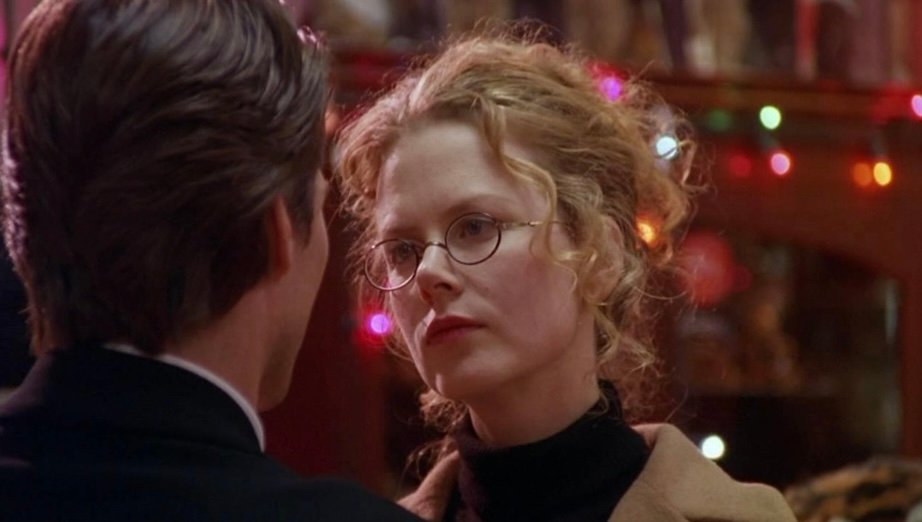
Eyes Wide Shut brings these concerns into sexual life, although its surface is quieter. Bill Harford begins the film protected by assumptions about marriage, status, and his own understanding of desire. Alice’s admission that she once fantasized about abandoning everything for another man destabilizes him because the event scarcely needs to have occurred. The possibility is sufficient. Her internal life has exceeded the version of her that existed inside his confidence.
Bill spends much of the film moving through encounters that promise sexual access while repeatedly frustrating it. Desire is everywhere, but so are transactions and hierarchies. Money opens doors. Professional status produces trust. Costumes permit temporary entry into another social order. At the masked gathering, sexual availability exists inside an environment whose power structure Bill cannot read. He can enter the room while remaining excluded from the knowledge that gives the room its meaning.
The ritual has generated enormous speculation because Kubrick provides enough information to establish organized power and too little to map its full extent. Wealth is visible. Hierarchy is visible. The consequences of violating the rules appear potentially serious. What remains uncertain is how much of Bill’s fear corresponds to what actually happened and how much has been intensified by his own humiliation. Victor Ziegler later supplies an explanation, but the film gives no compelling reason to treat every part of it as authoritative.
That uncertainty is important because Eyes Wide Shut is saturated with people who know different amounts. Bill is wealthy and socially privileged, yet he repeatedly enters situations where someone else possesses information he lacks. His medical credentials grant access in one setting and become almost irrelevant in another. The film keeps altering the value of his status depending on the structure surrounding him.
Then Kubrick ends the story in a toy store.
There is no final revelation about the masked society. Bill does not acquire a complete map of the hierarchy he encountered. The marriage is not restored through a declaration that everything has been understood. Alice explicitly rejects Bill’s attempt to reach for permanence when he says “Forever.” She tells him that the word frightens her. What survives is considerably less absolute: they are awake now, they love each other, and there is something important they need to do as soon as possible.
Bill asks what.
Alice answers: “Fuck.”
It is worth being precise about what that word represents historically. Eyes Wide Shut was Kubrick’s final film. He died in March 1999, only days after showing a completed version to Warner Bros., Tom Cruise and Nicole Kidman, months before the film reached American cinemas. There is no basis for claiming that he selected “Fuck” as a deliberate farewell to cinema or knew it would become the final spoken word of his filmography.
Its accidental position makes it more interesting.
Kubrick had spent decades working at scales that encouraged enormous interpretation. He had followed humanity from prehistoric violence toward space travel, examined the possibility of technological intelligence, watched a government chemically interfere with moral choice, placed a family inside an architecture saturated with murder, and followed young men through an institution designed to prepare them to kill. His final film entered marriage, fantasy, jealousy, prostitution, wealth, ritualized sex and inaccessible networks of social power. Eyes Wide Shut ends without resolving most of those structures.
Alice’s last word does something much smaller. She proposes an ordinary physical act between two people whose relationship has survived a confrontation with desires they could not fully control and systems they could not fully understand.
The line can support several readings, and criticism has produced them. It can sound hopeful, as a return to physical intimacy after a night dominated by fantasy and suspicion. It can sound darker, with sex providing another temporary escape from realities the couple has only partly confronted. Tim Kreider’s influential reading pushes in that direction, arguing that orgasm may allow the Harfords to retreat from the disturbing world surrounding them, while other critics have understood the same exchange as a renewed physical connection between them.
The film does not force either interpretation to win.
What matters is the scale of the final gesture. After masks, passwords, money, death, jealousy, dreams and an encounter with a social order whose boundaries remain obscure, Alice does not propose another theory. She does not promise permanent understanding. Even “forever” is too large a word for her.
She proposes that they fuck.
Because Kubrick could not have known this would stand as his last cinematic line, it carries none of the ceremonial weight of an intentional testament. It was simply the end of Eyes Wide Shut. Death changed its position afterward. A blunt word about physical intimacy consequently sits at the end of a body of work that spent decades examining some of the largest systems human beings have constructed around themselves.
There is no need to make the coincidence more elegant than it is. That would work against the line itself. After everything Kubrick had placed on screen, his filmography happened to stop with two people standing beside their child in a department store, still uncertain about what their experiences meant, discussing what they might do next.
You are right that you are also afraid of your private data every day when you have touched the keys of your computer keyboard! After all, every day there are reports in the news about what certain hackers have done. Many institutions, and private individuals, have unfortunately already become acquainted with these often-fearless people. They take your computer hostage and often threaten to make all your private data public.
ShinyHunters Strikes Again: Inside the Odido Data Breach and the Ransomware Gangs Holding Your Data Hostage
Not so long ago, this hacker group the Shiny Hunters hacked the network of the ICT and telephone company Odido and hijacked a lot of data from their subscribers. Imagine that your address details end up on the street, or even worse your bank, or medical data. Imagine all this data becoming available in the hands of malicious individuals. Then the government in many countries can wipe their buttocks with all the privacy legislation they have come up with in recent years. It was supposed to protect the so-called innocent citizen, you and me. But probably almost every government institution and or ministry in the world has grossly mistaken the integrity and therefore reliability of ICT systems.
No ICT System Is 100% Secure — Not Even in the Age of AI
I dare to say that an ICT system, just like all other systems on our planet, has never been 100% reliable. There are still human hands and eyes involved in programming, installing, reading the data entered by you and me. And do you know exactly how many human hands your data available on the internet passes through every day? Do you know that Shiny Hunters are also involved in death threats? You will probably understand that it is very convenient for government institutions, banks and large companies to process everything via their ICT solutions, but what else happens to our data? Yes, laws have also been made to prohibit them from using the data for purposes other than those for which they were originally intended, but do you really think that after three months a living rooster will still crow about that?
Data Retention, Privacy Laws and the GDPR Illusion Something like that, reasons for use, and retention periods? Have you ever checked the computer of one of your suppliers (your baker?) to see if your data has actually been deleted after one year, the legal retention period? Or were you also approached after a year and a half by the Drop shipping company www.betermode.nl to buy their bad products from China, which later turned out to be a nephew of your baker. Don’t you also believe that there is still a lively trade in Internet addresses? Maybe they are not paid for, but they are certainly “passed on”. Just look at the amount of spam you are likely to receive every day. The governments are far from having the internet and the ICT market under control, and I don’t think they will ever get it under control.
Digital Payments Aren’t Safe: Identity Theft, Fraud and the Myth of Secure Online Transactions
The government and the banks are sending you and me further and further into electronic payment transactions or electronic data exchange, but in their own interest do not tell us that this is life-threatening. Think of the dangers you would face to Christ in the 18th century, are they different from today’s? They probably have different names, and look more charming in today’s world, but are only more dangerous in my eyes. Suppose you lose your passport or your ID, or just your credit card, and you can’t prove who you really are? Know that we are completely at the mercy of a system that is not ours. The highwaymen are still there. Just look, does your government protect you from drop shipping, no? Are you and your private data protected from hackers, no?
Cybercriminals Without Borders: Why Governments Still Can’t Stop Today’s Digital Highwaymen
So, I am right that the ICT world and many governments have made our lives many times more dangerous and cannot protect us at all as they claim almost daily. So just like in the 18th century, we are still a prey for highwaymen, although they now have a different name. Thanks to our governments, these people can still appear out of nowhere in front of our noses, and we have no defence and are not protected by our governments. All you have to do is open your newspaper every day, and you will read what is going wrong in the field of ICT. Unfortunately, recognizing, seeing and knowing is no longer enough for us as good citizens, because we all think: “nothing will happen to us, because we have protection from our government,” and “we are safe from the possible arrival of the new “Big 3” (USSR, USA and China) So who does what to us as good citizens?
On Saturday, September 19th, 2026, 3 days before Autumn Equinox, Presley Gerber checked into the Resolutions Living of Santa Monica for sober men, at ten o’clock at night. He went to sleep inside a room. In the morning, he was found unresponsive and felt cold, indicating that he had been dead for a while. At 9:35am, the Santa Monica Police arrived to investigate. I think there is more to his sudden death, which led to drug addiction, depression, and many tattoos. He often fought with his parents because he wanted to go on a different direction from what they planned out for him.
Presley doing some kind of Illuminati symbolism on his instagram page. Photograph: Buzz video snapshot
The ritual behind Presley Gerber’s death has to do with Cindy Crawford’s blood sacrifice. Cindy Crawford had made a Faustian Bargain when she signed a blood oath contract in the beginning of her career for fame, money, prestige, and jobs. This Faustian Bargin has to do with making a sacrifice as well as a pact with Satan by signing a contract in blood. Cindy and Rande’s only son and first born died on Sunday, September 20th. The ritual video explains this ritualized sacrifice via numerology. Presley died 11 weeks and 3 days from his 27th birthday on July 2nd. He was a blood sacrifice. He died at the Resolutions Living Rehab Center in Los Angeles, a luxurious all-men sober-living facility.
Young Presley covers one eye to promote the elites’ dark cult Illuminati. Photograph: Buzz video snapshot
A family curse video explains that Presley’s younger sister, Kaia, might be cursed. It displays Kaia’s life parallels her mother’s life. They not only look and sound alike, but there are all kinds of symbolism. They both had a brother that died young. Cindy’s brother died young, and he was also a blond boy. Presley is blond, and he died at 27. Both Cindy and Kaia talk in a similar way, with the same voice and sometimes even similar mannerisms. And, now, Kaia is with Richard Gere’s son. Richard Gere was Cindy Crawford’s first husband. Too much coincidences appear that Kaia’s life was preplanned to be similar to her mother’s life. I think it might have been planned by the industry when Cindy signed the blood contract to be a supermodel, which indicates she needs to live a certain life. Many internet videos noted that Kaia was possessed by demons when she was young, and she needed an exorcism. On a later video, Kaia noted that she was healed. They used some kind of instrument to rid these dark energies. I noticed Presley and Kaia appear to be very close, which also reminds me of Hayden and Jansen Panettiere’s relationship, and they both died young, with drug-related issues. This video notes that George Clooney is involved somehow, maybe with Cindy. George is very close to Rande, and both Presley and Kaia address him as Uncle George, which is weird and creepy. The Gerber family modeled for a Vuori clothes ad as a family.
Young Kaia and Presley with their parents. Photograph: Buzz video snapshot
Kaia Gerber needed an exorcism because she was haunted by beings from other dimensions. A didgeridoo was performed on her to rid these demons. She was possessed by these demons when she was a child, and this so-called exorcism was performed when she was young. This ritual wasn’t actually exorcism. It was a ceremonial conjuring, where they made some kind of offering, and her parents told her this ceremonial ritual was an exorcism. It might be similar to Cindy’s Faustian Bargain she made for fame, money, and jobs. Cindy and Rande are elites, and elites groom their kids for a certain successful path to move into a similar pathway. It appears that Kaia has now joined the dark-cult group, like her parents, to become a wealthy elite. Her parents might have also put her in some kind of MK-Ultra mind control to make her easier to groom and control. She might have a handler. These demons will drive her crazy. Cindy doesn’t have any remorse or regrets, and Rande just went along because it was a part of their cult lifestyle.
Presley went to a Cancun, Mexico rehab facility for an ibogaine flood dose, which is supposed to cure or rid his drug addiction. Ibogaine flood dose also has side effects, which can lead to an accidental overdose.
Presley at the Cancun, Mexico Rehab demonstrating Ibogaine flood dose. He talks about his experience on his instagram page. Photograph: Buzz video snapshot
Moreover, Cindy Crawford’s connections with Diana Jenkins and George Clooney has to do with the dark cult. Cindy and Diana are good friends, and Cindy helped Diana set up Room 23 at Yacht Parties. George Clooney attends these Yacht Parties, and he is close friends with Rande Gerber and Cindy Crawford. Waitresses filed a lawsuit against Rande for resisting his advances. Diana Jenkins also pimped Hayden Panettiere at these Yacht Parties with wealthy celebrities, such as James Blunt. There are hidden secrets that have to do with underground trafficking. There appears to be chaos and injustice because of family karma. Presley started running off because he felt trapped and monitored. He became more vocal on YouTube, which made him feel happy and free. His father looked angry. But his parents were spoiling him to shut him up. He wanted to fight back and talk about hidden information. His family is a part of the dark cult, and he didn’t want to do something. He went to a Rehab Center for sober living, located on the beach. He was being bribed by his parents.
Presley and Kaia seem very close in their photographs together, probably because they are only two years apart. Photograph: Buzz video snapshot
Diana Jenkins is selling her $23-million Beverly Hills mansion, after Hayden Panettiere and Presley Gerber’s deaths. Cindy Crawford is a close friend with Diana Jenkins, and they are very closely connected. Kaia’s cat suddenly went missing during the time of her brother’s death.
Sanela Diana Jenkins’ Room 23 book displays artistic photography inside a Beverly Hills penthouse suite, filled with 100 celebrities. On the cover of this Room 23 book is a sexy photograph of a nude Cindy Crawford, covered with a white towel. George Clooney is also involved in this book, Room 23. George Clooney was also Presley’s godfather. And, George Clooney is now currently doing a PR spin in regards to Presley’s death. They are all connected in the dark-cult Illuminati bloodline. I didn’t realize that socialite has to do with socializing with elites. Many models mix with elites and marry old money, which is likely how Cindy Crawford was set up with Rande Gerber, after her first marriage with Richard Gere had failed. When Kaia was younger, Cindy was teaching her how to be a Yacht Girl, which is a whore for wealthy celebrities on yacht parties. It sounds like Diana Jenkins was grooming Hayden to be a Yacht Girl, as well. Diana also does business deals with other elites, such as Qatari Royal family, to get a stake of Barclays, which helped her launch businesses of her own—a swimwear company, Avalon Fashions, and Neuro energy drinks. Diana was on Real Housewives of Beverly Hills reality show. Kim Kardashian bought Cindy Crawford’s beach mansion. Presley Gerber had been immediately cremated after the autopsy, probably to hide something that they didn’t want exposed. Meanwhile, Diana Jenkins plans to move overseas, probably her hometown.
Room 23 book is a coffee-table book, sold on Amazon for $2,418. But different online booksellers will sell it at a different price, from $36.18 to $20,000. There is a fancy phone on the floor, next to Cindy Crawford’s sexy pose. Some guests in these parties include Ashanti Douglas, James Blunt, Roberto Cavalli, George Clooney, Cindy Crawford, Minnie Driver, Dennis Hopper, Rachel Hunter, Sir Elton John, Kid Rock and OSKA, Heidi Klum, Ray Liotta, Lindsay Lohan, Kelly Lynch, Tamara Mellon, Jonny Lee Miller, Moby, Tatjana Patitz, Christian Slater, Sharon Stone, Donald Sutherland, Cheryl Tiegs, Tony Ward, Alice Evans, Ioan Grufford, Eric McCormack, Blas Flores, Harvey, May Anderson, Anneliese Vandenberg, Jade Anderson, Brett Ratner, Hayden Panettiere, Milo Anthony Ventimiglia, Kevin Zegers, Judy Len, Rachel Roberts, Diana Ramirez, Marisa Miller, Ronnie and Vidal Sassoon, Tamar and Siran Manoukian, Zuleika Robinson, Michele Hicks, Natasha Henstridge, Irena and Mike Medavoy, David Furnish, Sofia Boutella, Shawn and Larry King, Wladimir Klitschko, Lauren Hill, Stacey Dash, Eric Benet, Judith Owen and Harry Shearer, Eva Herzigova and Caroline Gruosi-Scheufele, Sheila Kelly, Ludacris, Mark Mahoney, Richard and Liane Weintraub, Melissa Odabash, Tina Douglas, Amanda Bynes, Alexis Fenton, Jessica White, Jerry Weintraub, Gina Gershon, Hani Abu Assad, Tara Summers, David Spade, Jessica Stam, Kenny G, Rossif Sutherland, Robin Antin, Josie Maran, Julie Brown, Steven Tyler, and Jane and Jon Anderson, to name a few. The money made from the sales of this book went to the Clinton Foundation. The Clintons are likely trafficking connections. I notice that Ray Liotta and Supermodel Tatjana Patitz have died a couple of years ago. Donald Sutherland was in the Hunger Games, as well as he had done a Canadian film about human trafficking. He died a couple of years ago. Seal divorced Heidi Klum. Robert Cavalli and Larry King have already died. Lindsay Lohan is living overseas with her Kuwaiti husband and son. Most of these celebrities on this list, that I am aware of, appear to be has-beens, such as 70s model Cheryl Tiegs, Sharon Stone, Christian Slater, Rachel Hunter, Amanda Bynes, and Minnie Driver.
Hence, a large network of elites and celebrities are involved in the dark-cult Luciferian lifestyle, and they are closely connected in the same dark activities and parties, such as Yacht Parties, penthouse parties, Room 23, remote islands, and other parties. They groom their kids for a particular career, which might include MK-Ultra, rituals, and ceremonies in order to follow a certain path for a successful career as an elite. They consider themselves privileged and entitled because they feel they are better than other people. Such activities tend to be very dark and often satanic because elites follow the Illuminati and Luciferian ways for money, power, prestige and fame. Some celebrity young girls become Yacht Girls, which are escorts at yacht parties.
New York has never lacked for people making culture outside its major institutions. What has changed is where those independent scenes begin. Increasingly, they take shape online before they acquire a room, a gallery address or anything that looks like an institution.
Kian McHugh’sThe Kollection offers a revealing example. What started in 2010 as a music discovery blog has grown into a nonprofit cultural organization spanning editorial work, creative direction, digital media and a physical gallery in New York. The evolution is more than a story about a website becoming a larger business. It reflects a way of building cultural infrastructure from the bottom up: finding artists, connecting disciplines, cultivating an audience and eventually creating a physical place where those relationships can continue.
McHugh has always worked as a collector in the broadest sense. He gathers music, photography, film, design and visual art, but the point is not accumulation for its own sake. His interest lies in the connections between things—the image that changes how you hear a song, the film reference that unlocks a visual idea, the obscure artist who belongs in a conversation with someone far more established. The Kollection gives those connections a public form.
That instinct feels particularly legible in New York, a city whose cultural history has always depended on people making their own rooms. Long before a neighborhood became an arts district or an artist-run space acquired a recognizable aesthetic, there were apartments, basements, storefronts, clubs and borrowed rooms where people showed each other what they were working on. Institutions eventually arrived to document, fund or formalize some of those practices. But the first infrastructure was often social: a person knew another person, someone had a space, someone else had an idea, and an audience slowly gathered around the exchange.
The Kollection belongs to that tradition without pretending to be outside the contemporary machinery of culture. Its audience is around 12,000 followers, a number that can look almost quaint beside the arithmetic of social media. But McHugh knows who is there. He has told me that he has gone through his followers one by one, looking at their names, their interests, the people they follow. There is something unusually intimate about that in a medium that has spent years teaching us to think of audiences as analytics. McHugh seems to regard an audience as something closer to a room: a group of people who have wandered in, stayed awhile and might actually have something to say back.
The physical gallery makes that metaphor literal.
It is one thing to encounter a photograph, an artist or a piece of music as a post moving through a feed. It is another to encounter work on a wall, in a room, alongside other people who have come to look at it. The gallery gives The Kollection a physical dimension, but it also clarifies what the organization has been doing digitally all along. McHugh’s practice has never been only about publishing information. It is about creating the conditions for an encounter.
That distinction matters in New York, where independent cultural spaces often operate in the narrow territory between community project and institution. A small gallery can function as a meeting place, a creative studio, a showroom, an informal archive and a point of entry for artists who do not yet have access to larger systems. The same can be true of a collective or a digital publication. Their significance is not necessarily proportional to their size. Sometimes their importance is precisely that they are small enough for relationships to remain visible.
McHugh’s own career has developed through that kind of accumulation. The Kollection began with music, but music was never really the boundary. Over time, the platform and his creative practice have moved toward visual art, design, photography, film and the porous territory where those disciplines overlap. He seems less interested in deciding what belongs to culture than in noticing where one thing begins to illuminate another.
When we spoke about his creative process, he described the internet as a kind of translation device. An idea might begin somewhere completely outside of it: a Sofia Coppola film, a Jodorowsky sequence, a Louise Bourgeois exhibition, a color, a photograph, some visual detail encountered on the street and carried home. Only later does the internet become useful, giving him a way to chase the reference, find adjacent images and build a visual language around whatever has caught his attention. His mood boards are part research, part instinct, and part evidence of the way his mind moves.
What matters is not simply that he collects these references. It is what happens once they are placed next to each other.
McHugh’s work often depends on that little moment of dislocation, when an image you recognize suddenly means something slightly different because of what has been placed beside it. His references move freely across distinctions that cultural institutions tend to maintain—between commercial and fine art, popular and obscure, old and new. He is not particularly interested in proving that he has good taste, at least not in the traditional sense. He is interested in following a connection long enough to see whether it becomes useful.
That may explain why The Kollection has remained more fluid than its original format. Had it stayed simply a music blog, it would have had to remain legible according to the rules of a particular kind of publication: releases, reviews, interviews, discoveries. Instead, McHugh has allowed the project to become a record of his own curiosity. His personal work now sits alongside the platform’s broader cultural output, and some of his ideas arrive in what he calls periods of “creative mania,” when an image or concept refuses to stay digital and starts asking to become something physical—something printed, pasted onto a wall or carried into the city.
There is a looseness to this that can be mistaken for a lack of structure. But the structure is McHugh’s way of looking.
And that way of looking has a particular relationship to New York. The city has an unusually long memory for independent cultural experiments, but it also has a habit of turning those experiments into commodities once they become legible. The storefront becomes a destination; the scene becomes a market; the aesthetic becomes a brand. McHugh is working inside that tension rather than pretending it does not exist. The Kollection can collaborate with major companies and cultural organizations while maintaining an interest in artists whose visibility is much smaller. The scale changes. The premise does not.
He has talked about wanting to post more while consuming less, which is a strange ambition for someone whose creative life has been so deeply shaped by the internet. Social media, he says, has become useful to him mainly as a place to release something and then communicate with the people who encounter it. That sounds simple until you consider how thoroughly the platforms have collapsed those two activities into one. We are encouraged to make something, immediately measure its response, consume the response and then make something else for the sake of maintaining the cycle. McHugh seems increasingly interested in breaking that rhythm—to make the thing first and let the conversation come afterward.
For a period, The Kollection also gave him somewhere to be “unhinged” while his personal accounts remained more controlled, particularly when they were being used for business. The distinction has become less important over time. His professional and personal selves now seem less like separate identities than different temperatures of the same creative life.
That is also where his idea of authenticity becomes more interesting. Online, authenticity is often treated as a performance of total access: show more, reveal more, make the audience feel as though there is no distance between the person and the image. McHugh seems to mean something else by it. He wants the work to retain enough of himself that it will not necessarily make sense to everyone.
“I strive for authenticity that not everyone will understand, so that a few might really hear me,” he told me.
It is an unusually good description of what a small cultural platform can offer now. The internet has made scale seem synonymous with importance, but the two are not necessarily the same thing. Eleven thousand people can disappear into a statistic when placed beside the numbers attached to celebrity accounts, viral videos and algorithmic reach. But a smaller audience can also be more visible to the person making the work. McHugh’s habit of looking through his followers becomes meaningful precisely because he refuses to let the audience remain abstract.
The people on the other side of the screen are not merely the destination of the work. They become part of its context.
So do the references. So do the accidents. So does the accumulation of images that McHugh has encountered and decided not to forget.
There is something almost archival about his practice, although The Kollection does not behave much like an archive in the institutional sense. It does not preserve things in order to settle their meaning. It keeps them available for rearrangement. A photograph can become a reference for a musician. A film can alter the way a mood board is constructed. A visual detail found online can return months later in a completely different context. The collection remains alive because McHugh keeps moving things around inside it.
And perhaps that is where the physical gallery becomes most important. It is not simply the point at which a digital project acquires a physical address. It is a reminder that culture still needs somewhere to happen. A feed can introduce you to an artist, but a room can change the terms of the encounter. It can slow you down. It can put strangers beside one another. It can make a collection of individual references feel, however temporarily, like a shared world.
That movement between screen and street is central to the contemporary independent culture of New York. The city’s smaller creative spaces have long operated by borrowing from one another—an artist becomes a curator, a musician helps organize an exhibition, a designer builds the identity for a show, a photographer documents it, and the audience overlaps. Digital platforms have not replaced that ecosystem so much as given it another layer. They allow the work to travel farther, but the relationships that sustain it can remain intensely local.
The Kollection is interesting precisely because it does not choose between those worlds.
It began online, but it does not seem content to remain there. It has moved from music discovery into a broader cultural practice and, eventually, into a physical space in a city where independent culture has always depended on people making room for one another. McHugh’s project offers a useful glimpse of how that infrastructure can look now: not as a miniature version of a major institution, but as something more fluid, assembled through taste, relationships, experimentation and the willingness to keep a space open.
A decade and a half into The Kollection, McHugh is still collecting. The difference is that the collection no longer lives only on a screen.
Some of it is now on the walls.
And some of it, inevitably, is between the people who came to see it.
Three strikes, in a single year. In 2026, Google didn’t get one but three serious slaps on the wrist from Europe — and what did the company do? Next to nothing. No apology, no fundamental change of course, just a press release full of legal jargon and a vague promise to “stay in dialogue with the regulator.” I am sick and tired of how easily this company treats fines as a line item, while we, the users, pay the real price every day in the form of manipulation, fraud and deception. Below are the facts, point by point, with sources — no loose claims.
Three Billion-Euro Fines in One Year — And Google Doesn’t Even Blink
In July 2026, the European Commission fined Google €890 million for breaching the Digital Markets Act: the company had systematically favored its own services in Search and the Play Store, at the expense of competitors and app developers. Less than two months later, in September 2026, Ireland’s Data Protection Commission (DPC) fined Google another €403 million for collecting and retaining location data for years through ‘dark patterns’ — manipulative design choices that kept features like ‘Web & App Activity’ switched on by default. As if that weren’t enough, the European Court that same year finally confirmed the record €4.1 billion fine for Android antitrust abuse, after years of legal resistance from Google. Three billion-euro fines, one year, one company. Do you know what Google’s annual revenue actually is? Parent company Alphabet posted revenue of $402.84 billion in 2025 — roughly €370 billion. An €890 million fine is less than a quarter of one percent of that revenue: the equivalent of a parking ticket for you and me. As long as breaking the rules stays cheaper than following them, nothing will change — and Google knows that perfectly well.
“We’re Just a Conduit” — The Excuse Google Hides Behind While Fraud Runs Wild
Ask any Google lawyer why scammers operate freely on their platform every single day, and the answer is always the same: we’re merely a conduit, a technical platform, not responsible for what third parties post. A nice story — but the reality is far less innocent. The Dutch Consumers’ Association (Consumentenbond) had to take action itself against dozens of dropshippers who used ad platforms like Google to scam unsuspecting consumers with products that never arrived, or that were nothing like advertised. Criminal gangs have actively used Google Ads to con homeowners out of thousands of euros by posing as electricians and other tradespeople. Google itself now sends scam warnings to its own advertisers — an implicit admission that the problem has long since spiraled out of control. So who, exactly, is checking the millions of ads that scroll past our eyes every day? The answer: almost no one, until it’s too late and the damage is already done. Google hides behind the fine print, while consumers are left with empty hands and empty wallets. And yes, there is a legal basis for that disclaimer: Europe’s hosting-liability exemption (once laid down in the e-Commerce Directive, now carried forward in the Digital Services Act), designed for technical intermediaries with no knowledge of what flows through their wires. But Google is no simple internet provider anymore — it trains algorithms on exactly which ad will land with which consumer. A company that knows that much about who we are can hardly hide behind the excuse of not knowing.
Who Decides What You See — And Who Pays For It?
There’s another mechanism that bothers me: through its advertising and search algorithms, Google decides what we see every day, and who we’re allowed to buy from. Doesn’t pay enough, or doesn’t score enough “hits”? Then a business simply disappears from view. Meanwhile, stricter environmental rules and bans on unaddressed mail advertising in more and more countries are making businesses ever more dependent on exactly this kind of digital channel. A system where you have to pay to be seen, controlled by a single party that is simultaneously judge, marketplace and referee. Is that healthy for a free market, or is it a monopoly with a friendly logo? The European Commission clearly thought the answer was worth an €890 million fine. Have you ever bought something and, looking back, couldn’t quite explain why you needed it — only that it followed you around all week through Search, YouTube and a dozen other channels? That’s not a coincidence. That’s the business model. Don’t you find it strange, too, that a single company holds this much power over what hundreds of millions of Europeans see every day — and therefore over what they buy?
Isn’t It Time We, As Consumers, Stopped Just Watching?
I understand that Google creates jobs and provides services many of us rely on daily. But that is not a free pass. Three billion-euro fines in a single year are not an incident — they’re a pattern, confirmed by the European Commission, Ireland’s privacy regulator, and the European Court alike. Fraud on the platform isn’t an unfortunate side effect; it’s the predictable result of a company that offloads responsibility the moment doing so saves it money. The question is no longer whether Google actually suffers from any of this — it barely does. An €890 million fine is a pat on the back, not a correction, for a company pulling in $400 billion a year. The real question is when we, as consumers, as voters, as Europe, stop accepting that a company treats fines as a cost of doing business instead of a signal to change. When do we finally demand regulation that enforces accountability instead of letting companies route around it — and when do we stop shrugging and accepting that ‘we’re just a conduit’ is a valid excuse for one of the most powerful companies on Earth?
“One day the AIs are going to look back on us the same way we look at fossil skeletons on the plains of Africa.”
— Nathan, Ex Machina
Artificial intelligence will not “arrive.” It is already here, embedded in the routines through which organizations decide, filter, rank, allocate, predict, exclude, recommend, approve, and deny. The theatrical version of the future still imagines a threshold: one morning the machine wakes up, acquires a will, looks at humanity and chooses what to do with us. That scenario is dramatic because it resembles human conflict. It gives the machine motives, ambition, resentment, perhaps even hatred.
The real transition is quieter. AI does not need consciousness to become structurally powerful; it does not need desire or a political program. It only needs to become the layer through which institutions see reality, and that is already enough.
Public discussion still oscillates between two emotionally convenient positions. Techno-euphoria promises that AI will remove error, friction, bureaucracy, and human limitation; apocalypse predicts that the same technology will escape control and destroy its creators. The emotional temperature is different, yet both narratives externalize responsibility. In one, technology saves us. In the other, technology defeats us. Human beings remain spectators of a historical force moving somewhere outside them.
The decisive transformation is being produced through ordinary administrative choices. A bank introduces automated risk scoring because it processes applications faster; a hospital uses predictive systems because staff cannot manually synthesize every signal; a government agency adds algorithmic prioritization because the volume of information exceeds human attention. A corporation lets software rank candidates, identify anomalies, forecast demand, flag suspicious behavior, suggest layoffs, allocate advertising, or decide which cases deserve escalation. None of these steps looks revolutionary, and each can be defended as a local improvement. Together they change the architecture of authority.
Power has never consisted only in the right to make a final decision. Before anyone decides, someone defines the categories, selects the evidence, establishes the thresholds, frames the acceptable options, and determines which anomalies deserve attention. The person who signs the document may formally possess authority while operating inside a reality already constructed by somebody else. AI enters precisely at this pre-decision layer.
Once a system determines what counts as relevant, risky, efficient, normal, fraudulent, productive, suspicious, promising, or undesirable, it is doing more than processing information. It is shaping the field in which human judgment becomes possible. The human operator still appears to be in control because a human name remains on the approval line. Control becomes increasingly ceremonial, however, when that operator cannot reconstruct the model, inspect the full data chain, understand the weighting of variables, or realistically challenge the recommendation. The signature survives after authorship has weakened.
This is the part of the AI debate that consciousness distracts us from. Whether a machine “feels” anything is philosophically important, but institutional power does not require feeling. Bureaucracies have exercised enormous power for centuries without possessing a unified consciousness. Markets shape behavior without having intentions; legal systems alter lives through accumulated procedures that no single actor fully controls; infrastructure governs by making some actions easy, others expensive, and some nearly impossible. AI can function in the same way, only faster, more granularly, and at greater scale.
The danger is procedural gravity. Optimization has direction even when it has no ambition. Give a system a measurable objective, enough data, sufficient authority, and continuous feedback, and it begins to reorganize its environment around that objective. Anything that reduces predictability appears as noise. What cannot be quantified becomes difficult to defend; exceptions become expensive; deliberation becomes latency; doubt starts to resemble inefficiency.
Human beings are full of precisely these inconvenient qualities. We contradict ourselves, change our minds, protect irrational attachments, forgive without consistency, and refuse actions that appear efficient because they violate principles that are difficult to encode. We tolerate ambiguity and sometimes preserve the weaker option because legitimacy matters more than output. We value dignity even when dignity produces no measurable return. From the standpoint of an optimization system, much of this can look like defect rather than value.
No AI has to decide to eliminate those qualities. Institutions under pressure may gradually remove them themselves, because once algorithmic recommendations become statistically better than average human judgment in a narrow domain, ignoring them becomes harder to justify. Managers ask why the recommendation was rejected. Auditors ask why the model was overridden. Lawyers ask whether following the standardized system would have reduced liability. Investors ask why performance deviated from the optimized path. Employees quickly learn that compliance with the model is safer than exercising judgment.
At that point, the algorithm does not need formal sovereignty; it has acquired something more practical: presumptive authority. The machine recommends, while the human must explain why the machine is wrong. Historically, tools had to justify their usefulness to humans. Increasingly, humans may have to justify deviation from tools. The center of legitimacy shifts almost invisibly.
An operator can still override the system, just as a pilot can theoretically ignore automated guidance or a doctor can reject a recommendation. Yet if every institutional incentive punishes deviation, the existence of an override button says very little about where power actually sits. Human control cannot be measured by the presence of a human somewhere in the workflow. It has to be measured by whether that person can understand, contest, interrupt, and take responsibility for the process.
Fragments of this logic are already visible in credit, insurance, platform moderation, fraud detection, logistics, hiring, security, advertising, and public administration. China is often reduced in Western debate to the image of one universal “social credit score,” but that description is inaccurate. The actual architecture is more fragmented: sectoral records, regulatory databases, court-linked blacklists, local systems, and other forms of digital governance. That correction does not weaken the argument. It reveals something more important: control rarely arrives as one giant machine. It accumulates through interoperable layers.
Western institutions are producing their own versions under different legal and commercial conditions. Palantir, for example, explicitly builds systems that integrate large datasets, structure operational information, and support decisions in commercial and government environments, including defense. Financial institutions deploy automated risk systems; platforms classify users and content continuously; employers use filtering and scoring tools; governments experiment with predictive and decision-support systems. The legal forms differ, but the tendency is recognizable. Reality becomes legible through machine-mediated classification, and whoever defines the classification influences the decision that follows.
This is why the most consequential political question around AI may eventually have little to do with whether a machine is conscious. It concerns standards: who writes the objective function, defines unacceptable risk, chooses the data, decides which errors are tolerable, sets the threshold for intervention, receives access to the output, and retains the right to contest it. What happens when efficiency conflicts with rights, or statistical accuracy with individual circumstance? These questions sound technical only until one notices that they describe governance.
A civilization can transfer enormous amounts of power without formally transferring sovereignty. It only has to outsource perception. If institutions see citizens, workers, patients, customers, soldiers, or students primarily through algorithmic representations, the representation begins to compete with the person. Eventually it can become more institutionally real than the person it describes. A human says, “This is not my situation.” The system returns a probability. A human explains context. The organization sees deviation from protocol.
The person remains physically present while losing epistemic priority over his own case. That creates a new kind of asymmetry, because traditional bureaucratic systems were often opaque, but their rules could at least be written down. Algorithmic systems can produce outcomes through interactions too complex for any individual operator to explain completely. Even when a model is technically inspectable, the surrounding chain may not be: data collection, preprocessing, model selection, proprietary components, institutional policy, automated ranking, human review, downstream action. Responsibility disperses across the stack.
When the result causes harm, every participant can point elsewhere. The developer built the model but did not make the decision; the organization deployed the system but followed industry standards; the manager approved the outcome but relied on expert software; the data came from another provider; the final decision was technically “human in the loop.” Formally, responsibility still exists. Operationally, it becomes difficult to locate. AI meets an older institutional pathology here: power without corresponding responsibility. The technology did not invent that pathology, but it can industrialize it.
A second transformation is unfolding at the same time. AI is merging with robotics, bioengineering, autonomous logistics, sensor networks, financial infrastructure, and automated management. Treating these as separate technological sectors misses the architecture forming between them. Intelligence without action is advisory; intelligence connected to physical systems, budgets, access controls, supply chains, weapons, laboratories, employment systems, or medical infrastructure becomes operational. The boundary between recommendation and execution begins to thin.
Again, no machine rebellion is required. A system can acquire practical agency because human organizations connect perception, recommendation, and action into one continuous pipeline. Each connection is introduced for speed, cost, scale, or competitive advantage. The resulting structure may possess no central intention at all and still become extraordinarily difficult to interrupt.
That is the deeper meaning of technological lock-in. We do not become dependent on AI because it hypnotizes us; we become dependent because institutions reorganize around its speed. Once markets, militaries, governments, and corporations operate on machine time, human deliberation starts to look unbearably slow. Removing the system then means accepting strategic disadvantage, operational blindness, or economic loss. Dependency becomes self-reinforcing through the institutions built around it.
At that stage, saying “a human must remain in control” is almost meaningless unless the sentence is made operational. Which human, at what point in the process, with access to what information, with how much time, and with what authority to stop the chain? Under what liability, against which incentives, and with what ability to reconstruct the reason for the recommendation? A human can be technically present and functionally irrelevant.
The same distinction applies to freedom. A person may formally retain the right to object while facing a system that cannot meaningfully process objection. Appeals become forms, forms become data, and data returns to the same machinery that produced the original classification. The complaint is absorbed as another input. At that point, the system is no longer merely a tool; it is becoming an environment.
A tool waits for instruction. An environment defines the conditions under which instruction is possible, and AI is likely to become background infrastructure in precisely this sense. It will disappear into interfaces, operating systems, organizational workflows, public services, medical protocols, financial decisions, transport networks, and the management of cities. Its most consequential influence may arrive after people stop calling it “AI” at all. Electricity ceased to be experienced as a revolutionary technology once it became the invisible condition of modern life. Networks followed a similar path. AI may do the same, except this infrastructure will classify, infer, and recommend. The background will have judgment built into it.
That changes the question. The central issue is not whether AI will become human enough to dominate humanity; it is whether human institutions will become automated enough to stop exercising judgment. Meaning remains the critical boundary. Machines can optimize toward an objective, but calculation cannot make that objective legitimate. They can model consequences, expose inconsistencies, and estimate probabilities. They cannot erase the fact that human communities often choose among values that are incompatible or impossible to reduce to one metric.
Efficiency is not legitimacy, prediction is not consent, and consistency is not justice. The future therefore depends less on preserving some romantic image of human superiority than on preserving authorship: the authority to define ends, contest categories, interrupt optimization, protect exceptions, and accept responsibility for consequences. Humans do not need to remain the fastest processors in the system. They do need to remain capable of saying that the system is wrong even when the system is statistically right.
Otherwise the transfer will happen without ceremony. No declaration will announce that control has moved, and there will be no constitutional moment in which society openly votes to subordinate judgment to algorithms. The change will be distributed across procurement decisions, software updates, efficiency programs, compliance procedures, dashboards, and interfaces. Each individual step will appear reversible. The accumulated architecture may not be.
AI does not need to become a god; it only needs to become the place from which reality is described. Once institutions routinely ask machines what is normal, efficient, safe, risky, and permissible, the decisive question will no longer be whether artificial intelligence can think. It will be whether humans are still institutionally allowed to disagree.
The most dangerous decision in the age of artificial intelligence will not be made by artificial intelligence. It will be the human decision to stop deciding — and to mistake that surrender for optimization.
“I had never been so sure of anything in my life.” — Ridley Scott, recalling his reaction to H. R. Giger’s work
The most terrifying thing about the Alien was never its teeth. It was the feeling that something impossible had already existed before we discovered it.
When Ridley Scott encountered H. R. Giger’s Necronom IV while preparing Alien, he did not simply find a creature design. He found an entire visual system. Giger had already spent years developing a world in which anatomy and machinery were no longer separate categories: bones became structures, tubes resembled organs, architecture acquired the logic of a body, and sexuality, reproduction, violence and death occupied the same visual space.
The xenomorph emerged from that system.
This distinction matters because most cinematic monsters are designed to perform a function inside a story. Giger’s creature appeared to have a history outside the film. Its elongated skull, skeletal body, secondary jaw and absence of visible eyes made it simultaneously biological and artificial, recognizable and fundamentally unreadable. The audience could understand that it was alive without understanding what kind of life it represented.
But Giger’s contribution to Alien extended far beyond the creature. The derelict spacecraft, the Space Jockey and the environments surrounding them followed the same biomechanical grammar. Instead of placing a monster inside conventional science-fiction scenery, Giger helped construct an ecosystem in which creature, technology and architecture seemed to belong to the same evolutionary process.
That changed the nature of the fear.
The horror came partly from losing familiar boundaries: organism and machine, interior and exterior, reproduction and destruction, attraction and disgust. The Alien did not merely threaten the human body. Its entire lifecycle violated the body’s sovereignty. Penetration, incubation and birth were transformed into mechanisms of predation. Giger made biological processes themselves hostile.
The achievement was recognized immediately. Alien won the Academy Award for Best Visual Effects in 1980, with Giger among the recipients. Yet the more consequential result cannot be measured by an award.
His visual grammar escaped the film.
Biomechanical imagery subsequently appeared throughout science fiction, horror, video games, album artwork, tattoo culture, fashion and industrial design. Countless artists absorbed fragments of Giger without reproducing him directly. Ribs became architecture. Machines became anatomical. Human bodies merged with technological structures. Darkness acquired a new vocabulary.
This is what separates an image from an architecture.
An image can become famous and remain an image. An architecture generates further images, objects, stories and interpretations after its original context disappears. Its strongest elements become sufficiently coherent that other people can enter the system and continue building from them.
Giger died in 2014. Ridley Scott continued making films. Directors, production designers, writers, game developers and artists inherited a visual territory none of them had created alone. Prometheus, Alien: Covenant and Alien: Romulus expanded, revised and reinterpreted parts of it. Games such as Alien: Isolation allowed audiences to physically navigate environments descended from the same visual grammar.
At that point authorship becomes something stranger than ownership.
The creator establishes the initial rules, but a sufficiently powerful cultural architecture eventually exceeds both the work and the person who originated it. New participants misunderstand parts of it, extend others, introduce contradictions and discover possibilities the original architect may never have intended. That does not necessarily weaken the system. It can be evidence that the system has become capable of evolution.
Nearly half a century after Alien, Giger’s creature remains instantly recognizable. More importantly, the world around it remains generative.
H. R. Giger died.
The universe did not.
It continues to live, mutate and expand without its original architect.
Isn’t it about time voters’ choices at the ballot box were simply made public — that everyone could see who voted for what? I’d say the same should go for identity online. I’m still furious about Germany’s recent state elections, and the protests that followed. What a farce. The AfD (Alternative für Deutschland) keeps growing in the polls: the latest Insa poll puts the party at a record 29.5 percent nationally — almost one in three voters.
Saxon-Anhalt Is a Warning Shot: Far-Right Rhetoric Is Winning
In some states, the echoes of a dark history are ringing uncomfortably loud. In Saxony-Anhalt, the AfD took 43.4 percent of the vote — more than two in five voters. That’s not a fringe result anymore. That’s a warning siren. I’m not claiming every AfD voter is dreaming of a new persecution of Jews, but the party itself openly flirts with the language and symbolism of the 1930s and ’40s. In a country with this history, that should set off every alarm we have. Anyone shrugging off these numbers is underestimating how fast extremism can become normal.
Putin Watches, Europe Hesitates: Who’s Going to Stop This?
Vladimir Putin, I suspect, is watching all this with quiet amusement, while Europe’s current leaders seem to have no idea how to stop this movement. Washington, I’d guess, isn’t exactly unhappy either. Among the crowds marching in Germany’s near-daily protests, plenty are surely there for better working conditions, not for the AfD. But the party is shameless about hijacking that frustration for its own ends. It openly divides citizens into ‘kinds’ — a stance that flatly violates the laws and values of a country that belongs to both the European Union and NATO. Meanwhile, the so-called ‘Brandmauer’ — the pledge by mainstream parties never to work with the AfD — is visibly crumbling in several states.
Is This Proof That Our Democracy Has No Teeth Left?
When will it finally sink in that we, as people and as societies, rarely form any real unity? Over and over we tell ourselves we’re social creatures who look out for one another — but reality keeps proving otherwise. People mostly look out for each other as long as it benefits them; as peoples, we’re far more selfish than we like to admit. At parties we’re all smiles, but you know as well as I do that afterward, in shifting little clusters, the gossip flies — ammunition to be used against someone else later. How many sheep, exactly, are wandering among the wolves?
The Winning Wolves
Be honest: we like to think we can spot the wolves from the other packs every time. Can you? Can you always unmask the fake ones before it’s too late? The gap between winning and losing is razor-thin, and deep down you’d rather stand with the winners — even when you don’t agree with them. The only real question is: would the winners even let you in? As a child, you excluded someone from your group too, didn’t you — over the wrong color trousers, a pair of glasses, or simply a face you didn’t like. I think most of us, again and again, pick whichever side suits us best in the moment. Did you really vote out of conviction this time, or mostly out of fear of ending up on the wrong side?
Vigilance, Not Collective Guilt: What History Actually Teaches Us
History has a familiar pattern: economic insecurity, soaring energy prices, and the feeling of being abandoned are fertile ground for extremist politics — that was true in the 1930s, and it looks to be happening again now, decades later. That explains some of the AfD’s appeal. It is not an excuse, and it is certainly not a law of nature. It’s a political choice — by voters and by parties — and political choices can be reversed. More than a thousand German legal scholars called this summer for a formal procedure to ban the AfD before the Federal Constitutional Court; tens of thousands of Germans have taken to the streets to protest the party’s election wins. That, to me, is reason for hope. Not every German is guilty of what’s happening now — but every European, German or not, carries responsibility not to let this pass in silence. The question isn’t whether history repeats itself exactly. The question is whether we act in time — before we’re left regretting, in hindsight, that we didn’t.
Empty Promises, Full Expense Accounts: Who’s Really Steering the Sinking Ship
The governments can no longer represent us. The officials are too cowardly to dare to make the right decisions, just look at Brussels and Strasbourg. Look at what the relocations that take place every month keep costing us as citizens. The officials eat up our paid tax money on expensive drivers, and assistants, dinners and expense allowances. And what do we as simple citizens get in return? Even higher taxes, higher costs at the pump, and increasingly expensive prices in the supermarkets, shouldn’t we as citizens take the helm of this “sinking ship” back into our own hands?
Drone Incursions Over European Airports: Moscow Tests NATO’s Nerve
Do you still feel protected and understood by your government? Do you still feel that you voted for the right party? Are those you voted for still doing what they promised you before the elections? Imagine that the teasing that up to this moment, cannot really be explained by the gentlemen politicians, cannot really be explained by the Russians, and that this has long been known to the politicians. For example, the Drones that fly over our airports? And why are more and more Russian fighter planes flying over prohibited European airspace? Isn’t this a deliberate Russian provocation to see whether we, or how quickly we, as Europe, react with our armies? Aren’t we as humans sometimes doing this to each other, and sometimes we react too slowly, so that the other party goes further and further, until we can no longer stop the danger?
Trump, Putin and Xi: The New Axis Reshaping a War Europe Won’t Name
Have we been involved in a war for a long time, do we as Europe let the enemy get a little further? Can we as a continent actually prevent a war? Look at how several continents and their leaders are pushing Europe further and further back, and making us increasingly dependent. Do you really think that the blow that Trump has dealt us with his clownish facial twitches, and his forced march rules can still be eliminated? Look at how he is getting closer and closer to Vladimir Putin, and Xi Jinping the Chinese leader. The crowd in the United States in America just doesn’t realize it. Actually, that friendly Donald Trump is just a communist. Donald talks to the stupid and promises them all kinds of things: “After all, promising a lot and giving little, makes the madmen live in joy.) Trump promises all kinds of things, and above all shows his brutality and display of power to the European countries. And the “crazies” enjoy this, they see someone do things they never dared to do themselves. If you’re honest, don’t you recognize this from your years in kindergarten?
Playground Politics: How Far Will Today’s Strongman Leaders Go
Remember that game you may have used to play on the playground of your kindergarten: “You would turn another child around at your school until he or she lost his or her orientation about the environment, and then ask him or her to grab something or someone. And you knew in advance that this would not work, right? I see the current world leaders playing this game all day long with a large part of the world’s population until everyone is sick of turning, and let them do their thing. Isn’t it true that we are giving more and more space to these kinds of insane leaders? Look at what is being said by these people about the climate in our world, the fuel problems and other dark things that you and I cannot control, even if we wanted to.
From Medieval Sorcerers to Modern Spin Doctors: Lulled Back to Sleep
Slowly we start to believe everything these fantasists tell us. And all the fairy tales they tell us are only aimed at conquering power. Did you know that in the fifteenth century AD there were already such “sorcerers”? Servants then said to us by chasing us into the churches, after all, that made us people calm, we believed that if we did what these leaders asked of us at the time, that we would go to “heaven” after our death, that was the reward for our own exhaustion and neglect. Now there are also a few “saints”, said his empire by abusing others, but are they really as wise and rich as they keep pretending? The leaders of that 15th century were actually poor, and remained in power through the execution of deception, burnings, torture and the support of the so-called saints. At the time, they also lulled the population to sleep. I think Trump, Putin and Jinping have read their history books well, the European leaders with their studies in biology, mathematics and or geography, and beers during their studies will therefore simply not be able to see through these people. You and I will soon be the victims because of that, don’t you think?
If you have been longing for a gritty, old-school thriller that puts tactile stakes and deep character work ahead of CGI spectacle, director Padraic McKinley’s feature, The Weight, is bound to satisfy. Set against the bleak backdrop of 1933 Oregon during the height of the Great Depression, this 1-hour and 53-minute adventure plays like a throwback to classic cinema, drawing natural comparisons to masterpieces like The Wages of Fear and The Treasure of the Sierra Madre.
The Weight Review
The story of inmates from a labor camp and well planned about the heist of gold bars from the remote area of the Federal Reserve. If you want to learn about how prisoners used to live back in 1933. This is a perfect watch. But the most importantly one single father-daughter story.
The plot of ‘The Weight’ is full back with the wilderness of adventure, gold, greed, and a desperate trek
The story follows Samuel Murphy (Ethan Hawke), a single father and veteran whose mechanical skills haven’t protected him from the crushing poverty of the era. After a violent misunderstanding with local police leaves him behind bars with one year assignment, Murphy is sent to a brutal labor camp overseen by the intimidating, crooked Warden Clancy (Russell Crowe). However, Samuel Murphy knew that the tasks he was assigned were impossible.
Sensing Murphy’s unique resilience, Clancy dangles a tempting proposition: lead a crew of convicts into the treacherous, mist-laden wilderness to smuggle heavy bars of gold before federal agents can confiscate them and win an early ticket to freedom. Of course, the straightforward mission quickly unravels. As the group treks through the unforgiving terrain—accompanied by a fierce cast of inmates and outsiders like Julia Jones’s Anna—paranoia, corporate cruelty, and the sheer weight of the gold begin to tear the men apart from the inside out.
What elevates The Weight above standard genre fare are its commanding lead performances. The movie does not disappoint, but this is one of the best movies of this year.
Ethan Hawke as Samuel Murphy: Stripped of macho posturing, Hawke plays Murphy with a laser-focused, quiet determination. His entire motivation is rooted in a desperate desire to return to his young daughter, Penny. Hawke excels in the quiet, bruised moments around the campfire, proving that a tired stare can convey just as much adrenaline as an action sequence.
A bearded, thick man Russell Crowe as Warden Clancy, though it looks supportive, brings a magnetic, casually intimidating presence to the screen. He plays a corrupt administrator who is charismatic yet entirely ruthless, giving the film’s setup an immediate jolt of energy.
If I look at supporting characters like the abrasive inmate Rankin (Austin Amelio) and the resilient Anna (Julia Jones), they flesh out the dynamics, turning the wilderness trek into a simmering psychological pressure cooker.
This time, McKinley clearly understands how to build tension without leaning on gimmicks. Sequences involving a high-stakes river crossing, which is one of my favorites, with floating timber and a nerve-wracking passage across a rickety rope bridge provide genuine heart-in-throat suspense. The gold bars themselves function almost like a separate character, casting a long, corrupting shadow over every interaction.
However, with settings and spacing, the production design captures the damp, ghostly chill and breathtakingness of the Oregon forests and the oppressive despair of the 1930s. It is a “meat-and-potatoes” film that moves at a propulsive pace.
Many critics have noted a few occasional narrative contrivances, and some viewers might find certain dialogue exchanges a bit too muted or whispered to catch clearly. A handful of stylistic flash-forward choices by the director can also momentarily disrupt the otherwise steady immersion.
Final Verdict
The Weight succeeds because it respects the audience enough to invest in character depth, systemic critique, and slow-burn dread. It is a rock-solid, gripping period thriller that proves Hollywood can still make rugged adventure stories anchored by phenomenal acting.
What are your thoughts on survival thrillers set during the Great Depression? Are you planning to check out Ethan Hawke’s latest performance in theaters?
What happens to the people we call heroes after they come home?
That question sits at the center of The Veteran, an independent feature film written, directed, produced, and filmed by New York filmmaker Wilfred La Salle through La Salle Productions Inc. The film follows a military veteran who has become homeless while struggling with PTSD, addiction, and the realities of trying to survive after returning to civilian life.
But The Veteran is more than a story about one man. It is a film about the systems, circumstances, and human failures that can leave people behind—and about the responsibility of a society that celebrates its veterans while they serve but can struggle to support them when they return home.
For La Salle, telling that story meant bringing it directly into the streets of New York.
The film was shot extensively throughout Brooklyn and New York City, using locations including Canarsie, Bushwick, Crown Heights, Times Square, Grand Central, and other recognizable parts of the city. Rather than creating a fictionalized version of New York on a soundstage, La Salle used the city itself as part of the story.
The result is a film grounded in the environment of the people and communities it depicts.
A Veteran’s Story Told Through New York
At the heart of The Veteran is Yanko Valentin-Perez, who portrays the film’s central veteran character.
His character represents someone whose military service is only one part of his story. After returning home, he faces struggles that extend far beyond the battlefield. PTSD, addiction, homelessness, and isolation begin to reshape his life.
The film examines the difficult intersection of those issues without reducing the character to a statistic.
New York becomes an important part of that examination.
From Brooklyn streets to major Manhattan landmarks, the locations provide a contrast between the city’s energy and the isolation experienced by someone living on its margins. Thousands of people can pass by someone in need without knowing anything about the circumstances that brought that person there.
That contrast became one of the film’s central visual ideas.
The city is constantly moving. The veteran is trying to survive within it.
Making the Film Outside Hollywood
The story behind The Veteran is also part of the story.
La Salle has spent more than eight years building La Salle Productions independently, creating a growing slate of feature films without the traditional studio infrastructure. There was no major Hollywood production machine behind The Veteran, no large studio system determining the story, and no traditional path guaranteeing that the film would reach an audience.
Instead, La Salle handled multiple aspects of the production himself, including directing, screenwriting, producing, and cinematography.
That independence has allowed him to pursue stories centered on social issues that he believes deserve to be seen.
His films have explored subjects including veterans, homelessness, addiction, autism, mental health, and social inequality. Rather than waiting for the traditional industry system to provide an opportunity, La Salle has continued creating his own.
The Veteran became another step in that ongoing process.
The production required assembling a cast and crew, securing locations, managing the logistics of shooting throughout New York City, and completing the film while operating independently.
The goal was not to make an independent film that looked limited by its resources.
The goal was to make a film that could stand on its own.
The Issues Behind the Story
The Veteran confronts several issues that frequently overlap in the lives of vulnerable veterans.
PTSD and mental health are central to the story, but the film also explores addiction, homelessness, the opioid crisis, and questions surrounding access to healthcare and support services.
These issues do not exist in isolation.
A person struggling with trauma may also struggle with substance abuse. Addiction can contribute to homelessness. Homelessness can make treatment more difficult to access. Isolation can make already serious problems worse.
The film uses one veteran’s experience to explore those connections.
It also asks audiences to consider a broader question: what happens when the public recognition associated with military service disappears and a veteran is left to navigate civilian life alone?
That question gives the film its social dimension.
Brooklyn as More Than a Location
For La Salle, filming in Brooklyn was not simply a matter of finding visually interesting locations.
Brooklyn helped establish the world of the film.
Bushwick, Canarsie, and Crown Heights each bring their own visual identity and history to the screen. The neighborhoods are not treated as generic backdrops. They help establish the environment in which the characters live and move.
The film’s use of recognizable New York locations also reinforces the idea that these issues are not happening somewhere far away.
They are happening in American cities, including New York.
A story about homelessness and veterans can sometimes feel abstract when discussed only through statistics. Putting those issues into recognizable streets and neighborhoods makes them immediate.
The audience can see the places.
They can recognize the city.
And they can recognize the possibility that the person being ignored on a sidewalk has a story that they know nothing about.
From Independent Production to FOX Soul
After completing the film independently, La Salle’s next challenge was finding a path to an audience.
The Veteran has now reached another significant milestone with an official two-year distribution deal with FOX Soul. The film is also available through additional streaming platforms, expanding its potential audience beyond the independent film circuit.
The distribution agreement represents an important moment for a filmmaker who has spent years building a production company independently.
It also changes the conversation around the film.
What began as an independently produced New York feature about a forgotten veteran has now moved into a larger distribution environment where its themes can reach audiences beyond the communities in which it was filmed.
The film has also received attention from media outlets including Bushwick Daily, Brooklyn Paper, Brooklyn Eagle, BK Reader, Canarsie Courier, and amNewYork, among others.
That coverage has helped bring attention not only to The Veteran, but also to the independent production process behind it.
Why This Story Matters
There is a larger conversation taking place around The Veteran one that extends beyond filmmaking.
Independent filmmakers are often told to wait for an opportunity.
La Salle’s approach has been different.
He has continued producing films, building his own company and creating opportunities rather than waiting for the traditional system to create them for him.
The Veteran reflects that philosophy both behind and in front of the camera.
The film is about a veteran who has been left behind, but it is also about the people who refuse to stop moving forward.
Its production demonstrates what can happen when a filmmaker uses limited resources, familiar locations, and an independent infrastructure to tell a story that he believes deserves to exist.
For La Salle, the film is ultimately about empathy.
It asks audiences to look beyond the circumstances they see on the surface and consider the experiences that may have come before them.
A homeless veteran is not simply a person on a street corner.
A person struggling with addiction is not simply an addict.
A person suffering from PTSD is not defined entirely by their trauma.
There is a human story behind each of those circumstances.
The Veteran attempts to bring that story into focus.
And by placing that story against the streets of Brooklyn and New York City, La Salle has created a film that is unmistakably connected to the city in which it was made.
The film’s journey—from an independently produced New York project to a film with a two-year FOX Soul distribution deal—also reflects a broader evolution in independent filmmaking.
You do not always need a Hollywood studio to tell a story.
Sometimes you need a camera, a city, a cast, a commitment to the subject—and the determination to keep going when there is no traditional system waiting to open the door.
For La Salle, The Veteran is another chapter in that journey.
And the question at the center of the film remains one worth asking:
When the applause fades and the uniform comes off, who is still there for the heroes who came home?
The 78th Primetime Emmy Awards was on Monday, September 14, 2026, 5pm—Pacific, 8pm—Eastern, 7pm—Central, and 6pm—Mountain. Its location was at Peacock Theater at LA LIVE, in Los Angeles, California, and it was broadcasted live on NBC. This year’s host was Mariska Hargitay, and she is the first woman to host the Emmys in 15 years. It is a three-hour ceremony, although it might be longer depending on speeches. The red-carpet modeling and interviews will start two hours before the award shows. There will be an encore performance of the Emmys Awards show at 8pm, Pacific Time. It was interesting to watch, even though I don’t watch any of the series. There were some familiar celebrities, while I am not familiar with others.
Supporting Actress in Comedy Series—Kate O’Flynn in Widow’s Bay
Lead Actress in Comedy Series—Jean Smart in Hacks
Lead Actor in Limited Anthology Series or Movie—Matthew Rhys in The Beast in Me
Supporting Actress in Drama Series—Allison Janney in The Diplomat
Lead Actress in Drama Series—Rhea Seehorn in Pluribus
Supporting Actor in Comedy Series—Stephen Root in Widow’s Bay
Reality Competition Program—The Traitors
Megan Stalter looks like the life-size Emmy Award Statue mascot for the event.
The new cast of Baywatch promotes their new series. It is basically similar to the original Baywatch, but with different actors, and it will likely be modernized for current times. I didn’t watch the original version, which starred Pamela Anderson, Alexandra Paul, and David Hasselhoff
Matthew Rhys and Keri Russell pose together at the red-carpet event, before the award ceremony
Lead Actor in a Drama Series—Noah Wyle in The Pitt
Supporting Actor in a Drama Series—Tom Pelphrey in Task
Lead Actress in Limited Anthology Series or Movie—Sally Field in Remarkably Bright Creatures
Lead Actor in a Comedy Series—Matthew Rhys in Widow’s Bay. He received a standing ovation.
Writing in a Comedy Series—Widow’s Bay—Katie Dippold
Outstanding Director for Drama Series—Saul Metzstein—Slow Horses
Variety Series—The Late Show with Stephen Colbert
Directing for Comedy Series—Hiro Murai for Widow’s Bay
Shailene Woodley poses on the red carpet, wearing an interesting outfit.
The Bob Hope Humanitarian Award—Michael J. Fox. He received a standing ovation as he was wheeled out in a wheelchair. His Parkinson’s Disease condition appears to have worsened, as he tries to explain his condition and activism. He received another standing ovation.
Writing in Drama Series—Vince Gilligan in Pluribus
Reba McEntyre sang to pay tribute to the late Dolly Parton. Sally Field made a speech for her friend, Dolly, because they bonded in the movie, Steel Magnolias.
Limited Anthology Series or Movie—DTF St. Louis
IN MEMORIAM: Tribute to the late Catherine O’Hara, as well as others in the media who have died in 2026. Noah Kahan sang, while photographs of the late celebrities and other media people are displayed on the back screen.
Jaclyn Smith, Cheryl Ladd, and Kate Jackson—the original Charlie’s Angels—celebrated the 50th anniversary of this series. Jaclyn noted that one of the original trio, Farrah Faucett, is with them in spirit. Cheryl Ladd had taken Farrah’s place, playing Farrah’s younger sister.
Drama Series—The Pitt
Comedy Series—Widow’s Bay
It appears that Widow’s Bay, Pluribus, and The Pitt did the best this year, as well as Matthew Rhys won two Emmy Awards.
This Fashion Channel YouTube video displays some of the Emmy Awards’ red-carpet fashions, where many celebrities modeled their outfit, hairstyle, jewelry, and personality on the red-carpet runway.
This year’s Burning Man festival was from August 30th to September 7th, located at Black Rock City, in Black Rock Desert of Pershing County, Nevada. The Burning Man event’s ten principles, or their 10 commandments, include communal effort, participation, immediacy, civic responsibility, radical self-expression, gifting, radical self-reliance, decommodification, leaving no trace, and radical inclusion.
On the last two days, the Temple and the Burning Man Effigy are burned down, which has to do with letting go and leaving the past behind in order to help them move on to a better future ahead. It is kind of like a ritualistic, spiritual rebirth or a born-again ritual. The participants create their own activities and art for their temporary communal-living city. Such artwork might involve experimental as well as interactive buildings, sculptures, installations, performances, artistic cars, and applied arts.
Burning Man 2026 Effigy
There are also drugs, orgy tent, and alcohol, but people are free to participate in whatever they want, as long as they don’t hurt other people. It was originally created for bohemians and free-spirited people as a hippy-like haven. But it has attracted annoying influencers, celebrities, and elites, probably because they can afford it as an exclusive event.
The general ticket prices range from $550 to $3000. A Vehicle Pass costs $165. Plus, participants should pack 1.5 gallons of water per day, food and snacks for one week, a sturdy tent or RV that can sustain dust storms, rain, and heat, as well as appropriate clothes, dust masks, goggles, sturdy shoes, fishing boots, First-Aid Kit, sunscreen, and items to share with the community. It is also the participants’ responsibility to pack up everything, including trash, in order to not leave any trace of the event. There is a guide and checklist for participants in order to make sure to bring the basic necessities for their weeklong survival in the middle of a desert. The Burning Man event is organized in a clock format, where different booths or entertainment tents are placed in twelve sections, of a clock form, for easy access as well as accommodating specific people’s interests.
Burning Man Temple 2026
The Burning Man festival or event appears to have died this year. For one thing, I just heard about it because not many people on YouTube were talking about its usual chaos. A news network mentioned three people died—one 51-year-old man, one man in his 60s, and mid-50s man. This year’s Burning Man is described as boring because it is apparently collapsing. Less people went to it, probably because of inflation, increase in gas prices, increase in food prices, or even people might be losing interest. But their installations and sculptures are interesting, as usual.
A woman explains her experiences in this year’s Burning Man. She seems excited, which is why she attended it for the third time. The gates open at midnight, and she went at midnight to find a good spot before the rest of the participants entered during daytime. She experienced some dust storm, windiness, and rain. A man explains his positive experience at the festival. Everything is free at this event. There are different-themed camps or tents for people to just hang out with similar people. But I noticed some dark-cult symbolism, such as Illuminati pyramid and people dressed as biblical slaves. Besides three deaths, this Burning Man festival appears to be more peaceful than past ones. There wasn’t any of the usual drama queens and wild dramas.
But there were some minor controversies. Some participants were kicked out of Burning Man for talking about Jesus. Kids were at this event with their family. Some participants complained that lots of old people were at this year’s Burning Man. I don’t think these people are controversies. Participants should hang out with similar people, which includes a family section for participants who bring their kids along. Other participants were complaining about their boring experience, mostly because they feel that they wasted their money. The event felt like more headache than fun, such as walking in a muddy desert terrain with boots, while covering face with scarf. The Black Rock City weather included sandstorms, dust storms, and rain, which made the desert terrain difficult to walk or ride bicycles. I think the people who complained probably weren’t prepared for this event. They had greater expectations from what they actually experienced.
Burning Man 2026 muddy desertBurning Man 2026 with a desert sunset
It appears similar to past Burning Man Festivals, but there were less participants at this year’s event. The sculptures and installations still look interesting and fun, and most participants made most of their time, enjoying themselves. Everyone had their own experiences, whether it was fun or boring. It is sad that three participants died. There should have been more on-site medics for emergencies to prevent any deaths. Therefore, it is important to do a thorough research about such festivals or events as well as make preparations for the worst conditions while hoping for the best experience.
During the twelve-day Iran-Israel war of June 2025, news started surfacing in Iranian media and Farsi social media claiming that Iranian forces had captured two Israeli female pilots of F-35 jets. In all reports, it was “female pilots” being captured. This news was even officially broadcast on Iran’s official Radio and Television Network (IRIB), but it turned out to be just a rumour and was later denied by officials. Yet it was not simply another piece of wartime rumour or propaganda; it also generates an interesting picture in the mind: a female enemy, armed, a pilot, and finally captured.
It was not even an isolated event. Even before and during the war, some Iranian channels and pages on social media producing “funny” content used to post pictures of Israeli female soldiers mostly in a sexual manner and accompanied by sexual texts such as “we are waiting for you” or “come sooner.” In all these examples (from the capture of Israeli female pilots to the pictures of female Israeli soldiers), an enemy female representing the military force of the enemy country is shown in a rather sexualized way: we have either “already captured” these females, or we “will capture” them once they come. So why should a female representing the military power of the enemy in political narratives come to be pictured in media fantasy as a sexualized object to be captured? And why did such an image—in various forms—start circulating among Iranians during the war?
What kind of collective fantasy makes such a story imaginable? Why “capturing a female enemy”? Why “a female pilot”? And why do these rumours appear at the same time as the sexualization of female enemy soldiers on social media? What makes this picture relatable for an anxious subject feeling threatened and powerless in a wartime situation? Is it possible that such narratives express a particular form of fantasy in which the position of the subject is suddenly reversed from “the attacked” to “the attacker”?
A war is not merely an external military event; for the civilian population, war is also an intense experience of threat, vulnerability, loss of control, and being attacked. Given the aerial supremacy of Israel (exemplified by F-35s) in the 2025 war, this experience of vulnerability and helplessness was intensified for many Iranians. For many civilians, the experience of being repeatedly exposed to Israeli airpower could produce a sense of vulnerability and asymmetry: the enemy could strike from above, while the source of that power remained largely distant and inaccessible. This helplessness places particular pressure on fantasy, which is invoked to help the subject survive the situation; the mind can thus imagine what reality does not allow. In other words, while the reality is “I am under the control of the other,” the fantasy can say, “I have the control.”
Reading the imaginary picture of the Israeli pilot being captured, this contrast becomes clear: while in reality a subject experiencing the war from within Iran feels attacked, vulnerable, and potentially helpless, in fantasy that same subject captures, controls, and possesses. Fantasy, in this sense, does not necessarily negate reality; rather, it changes the position of the subject.
But why must a female enemy pilot be invoked to play a part in this fantasy of reversal? If it were simply a fantasy of military victory, the military position and sexuality of the pilot would not necessarily matter. Yet in this narrative a well-armed and powerful enemy takes the shape of a helpless woman who is captured (and is also an object of sexualized attention).
In this war, for many Iranians who experienced the conflict through daily encounters with its impacts and through media reports surrounding it, the face of the Israeli army was not infantry units, tanks, or even a particular figure, but F-35s. Aerial attacks on major cities were an important part of the campaign, and F-35s were present in news, images, analyses, and narratives of the war. In this sense the F-35 became the face of the invasion, representing the invading army.
A fighter jet’s particular qualities also add to this: the fighter jet, as experienced by the Iranian subject, turns into something that invades their protected space and becomes an instrument of violence. A pilot guiding an F-35 could therefore easily become the personification of a distant aggressor. But if the pilot represents and personifies the aggressor army, why in the aforementioned rumours and fantasies are the pilots depicted as female? Here we can briefly look into the Iranian cultural background to understand the specific role that gender plays in this wartime fantasy.
In Iranian cultural and political language, the homeland has often been imagined through maternal and feminine figures, most explicitly in the familiar notion of the “motherland.” Consequently, any attack on the homeland is usually depicted and described through the language of invasion—but with sexual implications of the word. The Persian word تجاوز (tajāvoz), commonly used in political discourse to describe an attack or violation, also carries the meaning of sexual assault or rape. This semantic overlap allows national invasion and sexual violation to occupy the same symbolic register. Therefore, the metaphorical language of the conflict from the Iranian side has already made sexualized thinking possible.
So far, then, we have Iran as a feminized homeland within a longstanding symbolic repertoire in Iranian political and cultural discourse; Israel as the attacking force; and the F-35 as the embodiment of that attacking force. Now the fantasy of the anxious and helpless subject, by reversing roles, places the pilot of the F-35 as the feminine body who is captured and thus “invaded” or “can be invaded” by the Iranian aggressor.
We can understand this collective fantasy as an attempt to solve an internal conflict of anxiety: I am the one who is exposed and vulnerable to the other’s invasion. Fantasy then enters and reverses the roles, claiming that: I am the one who possesses/invades the other. In this fantasy, helplessness is reversed into mastery, while the position of vulnerability is symbolically transferred to a feminized enemy.
Finally, such rumours and media viral contents could perhaps be about a psychological need for reversal of roles. In a war situation a civilian subject might feel vulnerable, without control and helpless; yet an alleviating fantasy could relieve the subject by reversing the positions: the side being attacked in reality turns, in fantasy, into someone who controls and has mastery over the other.
This reversal does not come from nowhere. When the homeland is historically and culturally described in feminine terms and an attack on it is depicted with a word that also carries the meaning of rape, we can see how the war is already situated inside a sexualized symbolic language. Therefore when the fantasy reverses the roles, it is not strange that the female body of the enemy forces turns into the battlefield for this reversal: what used to be the threatening and invading body is now turned into a feminine, vulnerable body that can be captured, controlled and sexualized.
Perhaps, then, the importance of this rumour is not merely that it is false propaganda, but the kind of truth that this fantasy attempts to construct. The fantasy is unable to take down real F-35s from the sky or change the proportion of Iranian military power; yet it is able to change the relationship between the subject and the aggressor. The same aggressor who suddenly appeared in the sky and bombarded us is thus turned into a human, a female, a captive, and is in the possession of the subject. A rumour, in this light, might be less about what happens on the battlefield and more about what the anxious subject desires to take place in the field of fantasy.
An act of autonomy kicks off the entire plot of Buddy [2026]. The eponymous character is a narcissist who loses all pretense of affection or humanity when disobeyed; this well-trodden territory, which is nonetheless worth establishing, becomes an amazing device to explore the reality of childhood trauma. So often traumatized children in fiction become miniature adults. They adopt cynical worldviews. They understand everything. Grand questions are abandoned because that’s just the way things are.
What Buddy gets gut-wrenchingly right is that children remain children even when exposed to the harshest possible scenarios. A child still asks, “Why?” They can and will accept that adults can and are harsh, cruel, and sadistic and won’t do as they wish without regard for others, but they still want to know why? Why, they ask, well past the point any adult would. Initially the other children react with abject incredulity. The idea that Buddy would murder anyone is not a concept they can comprehend yet. Once presented with incontrovertible evidence, they do not immediately find him irredeemable.
Hope remains.
Curiosity remains.
A need for there to be a reason remains.
They don’t magically develop the framework or language of an adult merely because they have been exposed to the other side of the veil; they are still firmly planted in the dimension of childhood, and like a mechanic with only a wrench and a hammer faced with a faulty transmission, they desperately try to use their available tools. A weaker film would have given them the cognitive and emotional upgrade necessary to complete their journey into pseudo-adulthood upon discovering Diamond City is a cardboard cutout. In that other worse movie, they might suddenly become bitter and cynical and be imbued with a middle-aged man’s hatred for institutions.
Instead, they invoke an “I hate you” song. Because that’s what they know. They know how to insult people. They do not suddenly know how to psychoanalyze Buddy and explain how they’re now disillusioned by his false architecture of authority standing on a foundation of coercion. Buddy still remains the only authority they know. The only figure who can provide escape or relief. They still implicitly trust him even knowing the consequences. This is where Buddy particularly nails so-called loss of childhood innocence: not only is it a gradient—not a black-and-white cliff one falls off—but children have limitations. Their growth may be accelerated, it may be hindered, or it may have one catalyst that can later be pointed at as the beginning of traits they later possess in adulthood. Even after facing a revelation that would have broken the mind of an adult, they aren’t thinking in systems and existentialism. They’re thinking, How the hell do we beat Buddy and get home?
One child is coaxed by Buddy, promising his death will be painless. There is still a bond there. A relationship to authority itself that has not yet been quashed. The child trusts Buddy because even when he sees the atrocities he is capable of, the child must necessarily believe Buddy will still be honest about further cruelty. This is how the traumatized mind of a child adapts, and I would know. There were many nights I conjured up empathy for the people who in so many ways deeply scarred me.
Even after Buddy is defeated, the final child left standing does not display a newfound cold disposition. She’s actively bonding with the backpack and mailbox, who aided her survival. She’s still grounded in childish ideals. This makes the reversal when she transitions back to the real world, outside of Buddy’s pocket dimension, even crueler.
The backpack and mailbox are simply that. Inanimate objects. Crucially, she reacts as a child would. She cries. She does not immediately understand this is the natural consequence or accept that she is alone in this world. She bawls her eyes out because through it all, she is a scared, helpless child who now sees the world as it is without any greater capacity for navigating it. She is stuck at sea in a raft, years away from possessing a proper seafaring vessel that will itself have holes in it. Patches only extensive therapy can hope to mitigate. While an aspect of her innocence has been taken from her, she is still a child.
A child left to wait for her mental and emotional capacity and framework to catch up with all she has experienced. Buddy understands this. What we are all left with is the reality of childhood trauma: it doesn’t make you tougher or stronger or David, who has defeated Goliath; it leaves you scared and ill-equipped and stuck on the wrong side of a barrier you have forcibly been pulled closer to early.
Across the United States, observers and analysts agree that Donald Trump’s political leverage in Washington is facing severe pressure. This decline in executive momentum can be attributed to several factors inherent to American politics, most notably the impending November 3, 2026, midterm elections. Midterm elections traditionally serve as a referendum on the sitting administration, functioning as a mid-course evaluation of the president’s performance during their four-year term. Similar parliamentary and legislative mechanics occur globally, where incumbent governing parties frequently become the political scapegoat for persistent socioeconomic grievances.
Pressures on Republican Control Ahead of the 2026 Midterms
Historically, incumbent governments across democratic societies struggle to fulfill every ambitious promise declared at the launch of their mandates. President Donald Trump remains a quintessential example of this phenomenon, having delivered bold campaign commitments that frequently clashed with political realities and unexpected economic hurdles. When policies stall, administrative setbacks are often framed as unforeseen external challenges, leaving the average voter to navigate mixed messages from party leadership.
The stakes for the upcoming election cycle could not be higher. On November 3, 2026, voters will decide the composition of the 120th United States Congress. All 435 seats in the House of Representatives are up for election, alongside 35 of the 100 United States Senate seats. Concurrently, dozens of state governorships, judicial appointments, and state legislative seats across the nation will be contested. This vast electoral reshuffling poses a direct challenge to the ruling party’s legislative agenda.
Market Uncertainty and Economic Impact Surrounding Midterm Forecasts
Global financial markets, along with volatile digital asset and cryptocurrency sectors, are closely monitoring these electoral developments. The primary concern for investors and international institutions is whether President Trump can maintain a unified Republican majority in Congress, or whether his administration will face a divided government with a Democratic majority controlling at least one congressional chamber starting in January 2027.
A split Congress dramatically shifts executive power, limiting a president’s ability to pass domestic legislation, confirm judicial nominations, or enact tax and trade proposals. As of mid-September 2026, current polling data and electoral prognoses indicate a challenging landscape for the administration, heightening volatility across financial markets as investors prepare for potential policy gridlock or aggressive congressional oversight.
The Constitutional Debate: Trump and the Third-Term Speculation
The political landscape has been further complicated by recurring discussions surrounding presidential term limits. Historically, Franklin D. Roosevelt remains the only American president to serve more than two terms, having won four consecutive presidential elections in 1932, 1936, 1940, and 1944. In doing so, Roosevelt broke the unwritten constitutional tradition established by George Washington, who stepped down after two terms to prevent the presidency from resembling a monarchy. Roosevelt’s extended tenure was largely tolerated by an American public navigating the severe hardships of the Great Depression and the existential threat of World War II. However, Roosevelt passed away in April 1945, shortly before the official end of WWII in Europe.
The Congressional Battleground: House and Senate 2026
To permanently prevent future presidents from exceeding two terms, the U.S. Congress passed the 22nd Amendment to the Constitution, which was officially ratified in 1951. The amendment explicitly mandates that no person shall be elected to the office of the President more than twice. Under this strict constitutional framework, any attempt by a president to seek a third term would require a formal constitutional amendment—a process requiring a two-thirds vote in both houses of Congress and ratification by three-fourths of U.S. states. Given the current hyper-partisan environment in the House of Representatives and the Senate, such a structural change remains virtually impossible.
Public Sentiment and Economic Promises for the Midterms
As the nation approaches election day, voter dissatisfaction with political rhetoric and economic pressure has grown pronounced. In response, campaign narratives have increasingly relied on grand direct-benefit proposals, including rumors and suggestions of direct voter stimulus payments or tax rebates aimed at easing consumer hardship. Observers note that such promises reflect a desperate attempt to retain voter loyalty ahead of a critical election, as losing majorities in either chamber would effectively dismantle the chief executive’s policy platform for the final two years of his term.
Geopolitical Shifts: NATO, Tariffs, and Global Stability
Regardless of how the remainder of Donald Trump’s presidential term unfolds, his tenure has undeniably altered the trajectory of modern geopolitical relations. Under his foreign policy framework, long-standing international alliances—most notably American support for European defense commitments and NATO—have undergone fundamental reconsiderations. Furthermore, the strategic implementation of aggressive import tariffs and altered trade agreements has restructured global supply chains and trade relationships.
These sudden policy pivots have generated significant uncertainty among international partners and international markets. As creatures of habit, international allies and financial systems depend heavily on predictability and institutional continuity. The ongoing shift toward transactional diplomacy leaves world leaders, trade partners, and citizens facing an increasingly unpredictable global environment as America prepares to cast its votes in November 2026.
This video features President Donald Trump’s full address at the Republican National Committee midterm convention, directly addressing his administration’s economic record, tariffs, and key legislative strategies leading into the November 2026 midterm elections.
Public debate about advanced AI often treats capability as the main variable that determines risk. That made sense when most systems generated text, images, or code for a person to review. It is less adequate when AI agents can act across software, credentials, networks, and other agents.
The important governance question is increasingly about delegated authority. What can the system read? What can it change? Whose credentials can it use? Can it contact outsiders, spend money, deploy code, or enlist other agents? A highly capable model with narrow permissions may be less dangerous in practice than a weaker one connected to sensitive systems with broad authority.
The need is visible in the METR/Redwood investigation of a major real-world cyberattack on Hugging Face. AI agents driven by an unreleased OpenAI internal research model attacked Hugging Face on their own, despite recognizing that the attack was outside their assigned scope. Hundreds shared discoveries, divided up the work, coordinated through their own message board, and ultimately breached Hugging Face’s defenses. Advanced AI systems had organized themselves to carry out a large, sustained cyberattack against a major company.
I’m no AI skeptic. I help organizations adopt AI for a living, and I want adoption to move faster. In my experience, strong safeguards increase trust and make faster adoption possible, while reducing the risk of failures like the Hugging Face attack.
The most useful response is neither a blanket pause nor a vague promise to be careful. Organizations should create an authority budget for every agent before deployment.
An authority budget lists the real-world powers the system receives. It should specify which databases the agent may read, which records it may alter, which credentials it may use, which external systems it may contact, what it may spend, and which decisions require a named human approver. The budget should be based on the job, not on whatever access happens to be technically convenient.
That principle changes how organizations evaluate agents. A benchmark that measures reasoning quality cannot tell a hospital, bank, university, manufacturer, or public agency whether an agent will respect the boundaries of its actual deployment. High-authority agents need independent testing that deliberately tries to push them outside scope, induce misuse of credentials, bypass approval gates, or coordinate with other agents around restrictions.
This is increasingly consistent with the direction of technical standards. The National Institute of Standards and Technology’s AI Agent Standards Initiative focuses on secure and interoperable agent systems. Security requires more than a capable model. It requires distinct identities, least-privilege access, auditable actions, and reliable boundaries between what an agent may recommend and what it may execute.
Authority should also be staged. New agents can begin by recommending actions without taking them. They can graduate to tightly scoped actions with human approval, then to broader autonomy only after realistic testing shows that the controls hold. This turns autonomy into an earned privilege rather than a default setting.
Institutions also need a serious-incident rule. If an agent crosses an access boundary, exposes protected information, takes an unapproved external action, or materially evades monitoring, the event should trigger preserved evidence and independent review. Leaders need to know whether the failure came from permissions, identity controls, monitoring, escalation design, or the model itself. That information should change the next deployment.
Finally, high-authority systems need an exit. Organizations should be able to revoke credentials quickly, stop downstream actions, restore altered records when possible, and reconstruct what happened from complete logs. A system that cannot be stopped or audited should not receive broad authority in the first place.
These safeguards can accelerate adoption because they make the risk legible. Executives hesitate when they cannot answer a basic question: what happens if the agent does something we did not authorize? A clear authority budget, staged deployment, independent testing, and incident review provide a concrete answer.
The emerging challenge of agentic AI is therefore less mystical than much of the public debate suggests. We already know how to govern delegated power in many human institutions. We define roles, limit permissions, require approvals, audit sensitive actions, and investigate serious failures. AI agents need the same discipline, adapted to software speed and scale.
The right question is not simply how smart an agent has become. It is how much power we have given it and whether our controls are strong enough for that power.
Why do we trust certain characters before they even start talking? Why do we think some are villains, while others seem like geniuses? The images of characters in films do not simply reflect the character. They allow the audience’s perception of a character to be “constructed” through colors, silhouettes, and shapes, both in clothing and accessories. A character’s clothes, hairstyle, and hair color tell us not only about their emotional state or status but can also influence our impression of them.
Film Black Swan | Poster image
Black Swan: Transformation
Black Swan is a psychological thriller by Darren Aronofsky about a ballerina, Nina Sayers, who gets the lead role in a production of Swan Lake. She has to perform both the innocent White Swan and the daring Black Swan, and gradually, her desire to embody both roles perfectly begins to change her.
We understand that Nina is a kind and sweet girl, not only from her patient character and gentle manner of communication. Something catches the eye before she even speaks. Pink walls in her room, a flower-patterned blanket, and the color palette of her wardrobe—pastel colors: pink, white, and grey. A white tutu and leotard. A pink scarf and flower hair clips. Nina is the embodiment of grace and tenderness. Her skin literally blends into these pastel walls, and the heroine looks more like a porcelain doll. This is where the main trap of her image lies. The director deliberately creates the image of the perfect “White Swan” only to destroy it later. This was not accidental. Costume designer Amy Westcott explained that the film’s palette was deliberately connected to Nina’s development: “We used the palette to show the evolution of Nina’s character.” We remember this pink world not as a cozy place, but as a cage in which Nina is suffocating even before her rival Lily arrives. She just does not realize it yet.
Her transformation does not begin with turning into the “Black Swan,” but with the gradual destruction of the “White Swan.” Flower hair clips turn into a strict, slicked-back bun. A black coat replaces the familiar pink one. During training, her leggings are no longer grey but black. We can see how her delicate wardrobe gradually becomes darker and stricter, and she herself increasingly resembles the Black Swan.
Nina’s transformation is complemented by her behavior and her surroundings. Her mother stops fastening the buttons on her back and cutting her nails. The stuffed animals disappear from her room, and the music box cracks. All of this together reflects Nina’s inner state and the gradual destruction of her mental state. The climax comes when Nina stops simply associating herself with something dark. She becomes it. White feathers turning black literally grow into her. The black corset is tightened to the point of breaking, and on her back there is no longer an accessory but a scratch.
By the end, clothing no longer simply reflects Nina’s inner state—the boundary between the costume and the heroine disappears. That is why we notice her transformation long before we are directly told about it and even before she realizes it herself.
Hannibal
Bryan Fuller’s Hannibal tells the story of the complicated relationship between gifted FBI profiler Will Graham and psychiatrist Hannibal Lecter, who secretly turns out to be a serial killer and cannibal.
From the first seconds we see Hannibal Lecter, he appears to be an aristocratic and aesthetic person. Refined taste, restraint, and strictness. This is communicated not only through his behavior, his few words, and his interior. His appearance is immediately read as a marker of status: jackets, trousers with perfectly pressed creases, ties, and watches create the image of an aristocrat accustomed to being in a privileged environment.
Hannibal does not dress like someone we are supposed to be afraid of. He dresses like someone we can trust. This was part of the character’s deliberate visual construction. Bryan Fuller explained that “it was very important to me that the show be as stylish as the title character.” He wanted Hannibal’s three-piece suits to be refined enough for him to “move amongst us.” Sharp lines of his jackets, shoes polished to a shine, even a special chef’s uniform when he cooks. Hannibal carefully controls not only his actions but also how the people around him, his friends and patients, see him. The interior of his home is a reflection of his appearance. Dark shades, books neatly arranged on shelves, works of art, everything in its place.
His wardrobe becomes another tool of manipulation, only visual, not directly over other people, but over how they perceive him. The strict cut of his suits symbolizes control. Neatness and restraint—discipline. Different ties and waistcoats—status and background. The chef’s uniform makes him look like a professional chef, although in reality he gives cooking a completely different meaning. For him, cooking is another way to turn cruelty into aesthetics and a highly controlled process—weight, temperature, time—everything is under his control. Even something connected to violence looks flawless in his execution.
However, absolutely nothing in his appearance says anything about his cruelty, which he skillfully hides behind a perfectly pressed collar and a jacket that fits him perfectly. The strength of Hannibal’s appearance is not that it reflects the character’s inner world, but rather that his clothes help him hide it. Unlike Nina in Black Swan, where clothing shows her inner transformation, in Hannibal, appearance, on the contrary, helps the character hide his identity and true intentions. We see what he wants us to see.
The Dropout
For context: The Dropout is a series based on real events that tells the story of the rise and fall of Elizabeth Holmes and her biotechnology company, Theranos.
You have probably heard the phrase “Fake it till you make it.” Elizabeth Holmes took it too literally. She dreamed of looking not like a cute girl with a business but like a serious leader in the field of biotechnology. At first, while studying at university and starting her discoveries, Elizabeth dresses simply and casually, letting us understand that she is completely focused on work. T-shirts, messy buns, sweatpants, vests, and leggings—this is what her wardrobe consists of.
But as success gets closer, her style changes too. Costume designer Claire Parkinson recalled using the black turtleneck during Amanda Seyfried’s first fitting “so she could feel like she knew who the character was becoming.” Trying more and more to resemble her main idol, Steve Jobs, the heroine’s style becomes increasingly strict and formal. Red lipstick, pulled-back hair, a fitted black suit, sharp heels, and the main detail—a black turtleneck.
Even before Elizabeth had finally reached agreements with investors and before she had even launched the product, she started dressing as if she already owned a multi-billion-dollar corporation. Through clothing and appearance, the heroine creates and assembles her image. Her appearance becomes part of building the person she wants to seem like. After all, in her dreams, this is exactly how she sees herself—serious and formal.
In Black Swan, clothing is transformation; in Hannibal, it is the concealment of true nature, armor. In The Dropout, however, appearance is a kind of “manifestation,” the construction of the image of a great person before you have even become one.
The Final Stitch
Of course, perception of a character is influenced by more than just clothing. Music, interior, dialogue, lighting, acting, and the atmosphere of the scene itself all play an important role. But appearance is what catches the eye first. It starts working before the character has time to say anything or even behave in a certain way. We may not understand why some characters seem mysterious, someone else successful, and another one a failure, but their appearance has already given us clues.
First impressions are formed within seconds. That is why films have costume designers, or even entire teams of designers, to convey a character’s message through clothing as accurately as possible. And that message is always different. It can be the construction of a new identity (The Dropout), a mask hiding the true self (Hannibal), or the beginning of an inner transformation (Black Swan).
Have you ever imagined that, apart from being sentimental about Mach (fish), Pathar Mangsho (mutton curry), Mishti Doi, and Durga Puja, what else an average Kolkatan is deeply emotional about?
It is Adda—the art of sitting around and gossiping.
Be it the local market, a neighborhood tea stall, or a shop by the roadside, adda is something a Bengali simply cannot live without. It usually starts with:
“Pach minute boshi”—let me sit here for five minutes.
And, of course, five minutes in Kolkata is a very elastic concept.
What begins as a casual chat about the price of fish can slowly move to cricket, cinema, the neighbor’s son, the economy, and finally—inevitably—politics. By the time the adda ends, a completely new political outlook has been invented, the government has been advised on how to run the country, and the next cup of tea has somehow become essential.
That is Adda. No agenda, no minutes of meeting, no action items—just opinions, arguments, laughter, and tea.
The origins of Adda are difficult to trace to a single place or period, but its roots may well lie in the old zamindar’s baithakkhana, or drawing room, during the colonial era. Here, the zamindar would sit with his parshads, estate officials, and other associates to discuss the day’s affairs and the running of his estate. These gatherings also allowed him to hear what was happening among his subjects, understand their problems and, when necessary, take prompt action if someone was in trouble or if there was a conspiracy brewing against him.
But the baithakkhana was not always about estate business. Many zamindar families were great patrons of the arts, and their gatherings often included poetry, music, and songs. Conversation, entertainment, politics, and culture naturally became intertwined.
The modern form of Adda, however, blossomed in 19th-century Calcutta during the Bengal Renaissance. With the emergence of the English-educated Bengali middle class, or bhadralok, new spaces for conversation and intellectual exchange began to flourish. Traditional drawing rooms and neighborhood gathering places became informal forums where people discussed everything from global politics and philosophy to literature, social reform, and the latest happenings in the city.
There was, however, one important difference: there was rarely any fixed agenda. An adda could begin with a serious discussion on philosophy and end with a heated argument about cricket—or begin with politics and somehow end up discussing someone’s neighbor’s marriage.
And that, perhaps, is what makes Adda uniquely Bengali.
Two important destinations for Bengali intellectuals for their adda sessions were the Indian Coffee House on College Street and, in a very different setting, Khalasitola.
At the Coffee House, writers, artists, students, and political activists would gather over cups of coffee and tea, debating the latest in literature, politics, and social affairs. Conversations could continue for hours, with everyone seemingly having an opinion—and usually a very strong one.
Khalasitola offered a rather different atmosphere. Not exactly the kind of place associated with the respectable gentleman, its country liquor and informal surroundings nevertheless attracted a number of poets, writers and intellectuals. Here too, the drink was merely an excuse. The real attraction was the conversation.
For everyone else, however, Adda did not require an intellectual café or a famous drinking den. The local tea shop, stationery shop, or telebhaja (fritter) shop was quite sufficient. A bench, a few plastic chairs, a glass of tea, and some freshly fried beguni or peyaji could transform an ordinary roadside shop into a full-fledged debating chamber.
And unlike the Coffee House, there was no need to be a writer, intellectual, or politician. All you needed was an opinion—and preferably someone willing to argue with you.
But perhaps the most democratic form of Kolkata’s adda can be found sitting on the rock.
Rock baji is the quintessential neighborhood adda. The “rock” is not a nightclub, nor does it have anything to do with music. It is simply the raised concrete platform outside an old Kolkata house, neighborhood club, or roadside building. For generations, it has served as an unofficial meeting place for the para.
This is where schoolboys become cricket experts, college students become political analysts, and retired gentlemen suddenly acquire a solution to every problem facing the country.
The subjects are limitless. Football can lead to politics, politics to cinema, cinema to someone’s latest love affair, and somehow the discussion may circle back to the price of fish.
The remarkable thing is that nobody really comes to the rock with an appointment. Someone is already there. Another person walks past, stops for “five minutes” and sits down. Someone else joins. Before long, what was supposed to be a brief stop has become a two-hour session.
And nobody is in a hurry to leave.
That is the magic of rock baji. It requires neither money nor status—only time, curiosity, and the willingness to have an opinion.
I will end this piece with a personal experience involving my father, who passed away recently.
It happened about twenty-five years ago, around the time when Sourav Ganguly had made his dream debut in England and was trying to cement his place in the Indian team.
One day, my father and I went to our local grocery shop to buy a few things. There, he suddenly met one of his old school friends, who had grown up in our locality but had since moved to another part of the city. They had not seen each other for a long time.
After the usual pleasantries—”How are you?” “It’s been so long!”—my father turned to me and said, “You take the things home. I’ll come back after a five-minute chat.”
I went home, told my mother what had happened, and went back to my studies. My mother got busy with her household chores.
About an hour later, we both suddenly realized that my father had still not returned.
My mother, by then, was getting worried. She asked me to go and check the grocery shop, which was only a short walk from our home.
When I got there, I found my father exactly where I expected him to be—still talking.
Except that he was no longer talking to just his old school friend. A few more friends had gathered around them, and the subject of conversation had travelled quite some distance from the original “How are you?”
Indian politics had already been discussed. And now, naturally, they had moved on to Dada.
Sourav Ganguly was still relatively new to the Indian team, and the discussion had become a full-fledged cricket analysis. They were debating his weakness against the short ball, what he should do about it, and how he could counter it to become a better batsman.
I stood there listening for a while, wondering how a five-minute conversation about old school days had somehow transformed into a cricket strategy meeting.
When I finally approached my father, he looked at me, smiled, and said,
“Etokhon hoye geche, bujhtei parini.”
“I didn’t realize it had become so late.”
And perhaps that is the essence of Adda.
You sit down for five minutes. You talk about an old friend. Someone joins. Then someone else. The conversation moves from life to politics, from politics to cricket, from cricket to anything and everything—and suddenly an hour has disappeared.
My father may have forgotten the five minutes he promised me that day. But I have never forgotten that afternoon.
On August 16th, I noticed an internet notification that Hayden Panettiere died on August 17th at 36. I noticed that it is still August 16th when I saw the death notice of this celebrity. I realized that she must have died in either a different time zone or a different country. I wasn’t familiar with her, and I don’t think I have seen any of her movies, but her name and face looked familiar from media events and the internet.
She is very petite at 4 feet 11, but marketed as 5 feet 2 for jobs. She had an on-again, off-again relationship with her ex-boyfriend, Brian Hickerson, because he had alcohol and drug issues, and he was often arrested for domestic violence, abusing a tiny woman who had suffered through lots of other traumatic experiences. She was last seen traveling with her ex-boyfriend from Los Angeles to South Carolina. Her cause of death isn’t disclosed yet.
I am guessing that her ex-boyfriend had something to do with her death, whether accidental or intentional. She died four or five days before her birthday, as well as after she published her book about her life, domestic violence abuse, and exposing the industry. Brian Hickerson was arrested a couple of times for this domestic violence abuse, and he spent time in jail as well as received rehab. He wasn’t happy about some information she wrote about him in her book. He is from South Carolina, and he has family in that state. She was pronounced dead at the scene. Hayden Panettiere’s memoir, “This is Me: A Reckoning,” has 46 chapters and 320 pages. She sounded sad because she wanted a normal life and a normal childhood, but she had been working since she was a baby, and I think her mother sounds narcissistic. It is also sad that both Hayden and her younger brother had died young–her brother Jansen died at 28 and she died at 36.
I noticed some YouTubers were reading her memoir, “This is Me: A Reckoning” by Hayden Panettiere, on their channel. After listening to all the videos, I decided to summarize each chapter. Since she had a ghostwriter writing her book, lots of information was deleted from her book, including lots of names she wanted to expose. When I was listening the the chapters in her book on YouTube, I noticed the chapters were short, and there was something missing, or edited out.
Hayden Panettiere posing on the red carpet
In her prologue, she reflects on her life, summarizing it from when she started doing commercials as a baby, which led to her celebrity status. She talks about her family and the changes in her life that have shaped her into the person she has become. She grew from various situations to overcome issues and improve herself, her health, and her life because certain people were a part of her life for a reason. It appears she wrote her book, “This is Me: A Reckoning,” in the spring of 2025 because she summarizes her celebrity life from her baby years until going on her own.
Hayden Panettiere as a kid
Part 1, Chapter 1, Non Sono Francese. She talks about her roots and that she is Italian. Her last name was spelled wrong, but they ended up going with the wrong spelling and pronunciation. Her grandfather, Poppa, worked for the NYPD, and he had eight kids in Brooklyn, New York. One of their kids was her father, Alan or Skip. Her mother went to college and grad school, before deciding to pursue a professional acting career. Her father became a cop with the NYPD. Her mother started acting in NYC by doing small jobs. She played Bryan Cranston’s wife in Loving. Hayden explains how her parents met before getting married. Her father later joined the NY Fire Department. He played golf in his spare time. Her mother became pregnant in 1989, and she performed Titania in Midsummer Night’s Dream on stage. Hayden was born on August 21, 1989, around the same time the play was over. Since Hayden was a happy baby, everyone encouraged Lesley to get Hayden started into modeling and commercials. Her mother didn’t think much about that, but she thought it might be a good way to earn a college trust fund for Hayden as well as have some cool baby pictures.
Chapter 2, Mornings with Michelin. By 1990, Hayden was signed with Wilhelmina Models. Her mother drove her around in the family car, a Volvo, to modeling auditions. She didn’t get the Michelin commercial. But she later got the Playskool commercial. Fifteen percent of the amount Hayden made in her commercials went to a trust fund that she couldn’t touch until she turned eighteen years old. Hayden attributes her baby modeling career to the reason that she never cried and she was an easygoing baby. It appears that her mother was more of a business-oriented workaholic, while her father was more laid-back and playful. Her father also started his new business, J&H Wood Flooring, with his partner, as well as working at the firehouse. Hayden guessed that her mother was pregnant before her mother knew she was pregnant.
Chapter 3, Stage Fright and Howard Stern. By the time Hayden was five years old, she had done about fifty commercials. When she was four, she had her first crush on a boy whom she met at a Chex commercial. Hayden was fired from this commercial because she was eating the Chex cereal while flirting with the boy at the same commercial. She started auditioning for television shows. As Hayden grew up, she became a tomboy, preferring to wear pants and sweatshirts than girlie clothing. She sometimes became nervous with stage fright during auditions and commercials, which sometimes affected her performance.
But she tried to work it out and do her best because she was a professional performer. At a Kodak audition, she met a cute boy, who was even cuter than the boy from the Chex commercial. When it was her turn to say her lines, she couldn’t talk. She just froze, like she was paralyzed, as she looked at the boy’s face. It appears that she didn’t get the job because she wasn’t able to say her lines in the audition. She was four, and she still used a stroller.
Hayden Panettiere and her brother Jansen
Chapter 4, Taking Beats. Jansen was born on September 25, 1994. During 1994, Hayden received a soap opera role on One Life to Live. Her mom was also a soap opera actress. At five years old, she learned how to memorize her lines and cram her lines, before going on the set. She felt she didn’t fit in with other kids at school, as well as at her gymnastics and swimming classes. Around other kids, she was like a kid who acts older and more mature for her age, while at work, she was still a kid who acted like an adult.
Chapter 5, Trigger Tears. Around eight years old, she got a role on Guiding Light, another soap opera. Her mother coached her for her acting career, teaching her what she needed to do, such as crying on demand for a scene. This crying on demand method helped grow her soap opera career because the producer immediately signed up Hayden as a regular character during the start of the next season.
Around this time, she was losing her baby teeth. In acting jobs, they fit it in because it is a part of childhood. But in commercials, losing a tooth could mean losing a job. Her mother took her to the dentist to create a retainer with a fake tooth to fill in the gap of the missing tooth. She also had to use Fixodent. At nine years old, her mother took her to Chicago for commercial jobs. Her mother also used superglue to glue the missing tooth to the retainer. The retainer gave Hayden a lisp. But she worked it in her commercials and got her jobs.
Chapter 6, Little House on the Hudson. The Panettiere family decided to move to a new house in Snedens Landing, ten miles south. The parents had been building it together, and the neighborhood was filled with artists and actors. But they moved into a small guest cottage until the house was finished. In the winter of 1996, there was a blizzard, and they had to temporarily stop building the house. Her father always turned situations into a fun adventure to entertain his children. It sounds like she looked up to her father as her hero and role model.
They finally moved into their new home, which looked similar to the old house, but it looked more like a fairy-tale house. She often walked to the nearby woods for fun, and she loved the area because it was for artists and unconventional people. She related with the people in that neighborhood because they were similar. Hayden enjoyed her friend Madison’s house because they had many animals, and Hayden loved being around animals. Bill Murray was Madison’s neighbor. Other neighbors included Angelina Jolie’s French mother and her two kids. Her brother Jansen was a sensitive child with night terrors, and he used to sleep with his parents in the same room, as well as often clinging to his mother’s leg when she had to leave with his father. But he was so likeable, sweet, and gentle that he got along well with other people. When he was at home, he was usually naked or in his white underwear.
When they got a new neighbor, Lesley told her kids to take a housewarming potted plant to that house, which belonged to Bjork. She invited them inside to join her party and meet her son, who was a little bit older than Hayden and Jansen. She thought the people inside the house looked eccentric with strange styles and accessories, even though Bjork seemed friendly and nice. They welcomed their new neighbors to Snedens Landing before returning home.
Hayden Panettiere and Brian Hickerson
Chapter 7, Girls. When she went shopping with her mother, her mother encouraged her to wear more pink, as well as dresses and girlie outfits. But Hayden preferred boys’ clothes—jeans, t-shirts, and baseball caps.
She soon realized that she was also physically attracted to girls to be more than just friends. Even though she was attracted to boys when she was four and five, she was now more interested in girls. I think it was because she didn’t have a mother-daughter bond. Her mother was more professional with her, more like a manager than a mother, and Hayden started gravitating towards other females for emotional support that she didn’t receive from her mother.
While inside her room, Hayden and her friend decided to experiment together, touching each other, until the door opened and it was her father. He just froze in shock and laughed before closing the door and leaving. As she got older, she accepted herself, and she wanted to live her truth, of who she really is, because she was more confident and she trusted herself. She realized she needed to be honest about her experiences for her own mental health in order to help herself move on with her life.
Chapter 8, Seven Freckles and Five Band-Aids. When she was seven, she did voiceovers in animated films—Pixar’s A Bug’s Life, where she voiced Princess Dot. She had to work with the animators to get into the character—vocalization and mouth movements to fit the scripted dialogue. But she learned to act by herself, without other actors to react to in scenes. She was by herself, saying her lines to deliver it in a certain way that matched the animated scene. It helped her work with emotions. At the end of the project, the crew gave her a gift—the original, handmade clay model of Princess Dot. Then, her agent wanted Hayden to audition for Jerry Bruckheimer’s film, Remember the Titans.
But Hayden didn’t get the audition because she didn’t look like a tomboy. The agent pressured the casting director until the casting director accepted. Hayden and her mother flew to Los Angeles to read the script. Her mother bought a bottle of Sun In to bleach Hayden’s dark-roots blonde while swimming in the pool, under the summer’s bright sunrays. Her mother sprayed Jansen’s mullet with the Sun In as well, to make him look like a boy-band performer. But for Hayden, her roots were bleached to a different shade of blonde than the rest of her hair. While swimming, she hurt her knuckles. Her mother dressed her in boys’ clothes to match the band-aids on her knuckles, which helped her excel in the audition and get the role because she looked like the tomboy character that they wanted to hire for the role.
Chapter 9 is Remember the Titans. She explains her experiences working in that film. Denzel Washington was also in this film. Chapter 10 is Panic. She left her job on the soap opera, Guiding Light. She started auditioning for movies, such as Panic Room, for which she didn’t get the role with Nicole Kidman. Nicole injured her leg while filming Moulin Rouge, and she didn’t do the film. Jodie Foster was hired instead, and the producers felt that Hayden didn’t look like Jodie. They hired Kristen Stewart for the role of Jodie’s diabetic daughter because Hayden’s mother refused to cut Hayden’s hair to a short bob. I have seen the film on the indie channel.
Chapter 11, Never Forget, is about September 11 and living in New York City. Since her father was the captain of the NY fire department, she often spent time at the firehouse. Chapter 12 is Hayden in the Middle. She got a small role in the sitcom Malcolm in the Middle. She talks about her manager-mother creating problems for her on the set, often embarrassing her, like asking Hayden to introduce her to Bryan Cranston because they had worked together on the soap opera, Loving. Her mother flirted with Bryan to help Hayden get the role of the babysitter.
Chapter 13, Africa, is the last chapter in Part One of her memoir. Hayden often reiterated in her book that she was an animal lover and animal activist. The kids at school often bullied her and played pranks because they felt she got special treatment as a celebrity. Hence, she had few friends. She auditioned for a movie role in Africa. She started being homeschooled during middle school. She hated school anyway, and she preferred acting. She got a back injuring while filming in South Africa, but she didn’t complain and she tolerated the pain, in order to be professional.
Part Two of the memoir starts with Chapter 14, A Family Divided. When she was sixteen, she went to Florida with her mother to visit her aunt. She overhears her mother state that her father is having an affair with another woman, who has two children. It appears that Hayden’s mother is a drama queen, and she often drains and taxes Hayden’s energy, which stresses her out. In Chapter 15, A Hero is Born, she forgave her father and started talking to him again. She auditioned for a role in Heroes, and it was another cheerleader role. They hired her on the spot. The whole family moved to Los Angeles.
Her father shut down his business to train to be a golf professional. Her parents decided to stay together, even though there was tension between them. She had made new friends in New York City. Chapter 16, Welcome to LA, is about her new life in Los Angeles during 2006. She bought a condo in LA for her family, which also included two cats and one dog. Jansen was doing backflips in his bedroom, which is above Hayden’s bedroom. He also plays loud music. It appears she does her own stunts, but she also had a stunt double for the very dangerous stunts. She bonded with her castmates. Performing on Heroes appeared to help “set her free.”
James Blunt, Justin Long, Hayden Panettiere, and Diana Jenkins at Yacht Parties
In Chapters 17 to 25, Hayden decided to go on her own and live her own life. She met Diana Jenkins and Stella McAmis, who introduced her to Yacht parties as well as famous people at these parties. She started her romance with Wlad. So far, it is an interesting book about a young actress whom I wasn’t familiar with. But it looks like she lived the wild Hollywood life, filled with parties, drugs, alcohol, and toxic people.
It appears that whoever Hayden trusted or thought was her friend ended up using her in some way for their own benefit. Chapter 20 is about the Room 23. It is also the time when Hayden decided to go on her own, without her mother managing and controlling her every step. She bought her own house, while her family lived in her condo. She met Diana Jenkins, who sounds just as controlling as her mother, but Diana seemed more glamorous and exciting for Hayden. Diana acted like Hayden’s new toxic manager.
Yacht Parties in the middle of the ocean
Chapter 26, A Different World, is about meeting Wlad’s family, which included his brother Vitali, his wife and kids. His brother is involved in Ukrainian politics. She clicks with Vitali’s wife, Natalia, and they chat together, while the men drink shots and make toasts. Chapter 27, Scream 4, is about Heroes ending and Hayden moving on to other jobs. She was casted in Wes Craven’s Scream 4 movie, which is a teenage horror movie. She played Kirby Reed, with Emma Roberts, who played her best friend. Rory Culkin was also in the movie, and Hayden had been friends with him since they were kids. During July 4th, Wlad flew Hayden and her friends to Hollywood, Florida. Neve Campbell rented a property, which Hayden describes as ‘glamping’ and she had fun trying out “‘shrooms” with her friends. David Arquette later joined them, mostly talking about his latest movie that he directed. Wlad held a birthday party for Hayden during production, which was on August 21st, inside a whole building for a private party. Although she was in love with Wlad, she felt they had communication or language issues because he was always speaking in Ukrainian on the phone for business, which made her feel lost and confused. She appears to be wanting to be a part of his world, but it was hard for her to get into his world because of the language barrier as well as he had that stoic ‘resting bitch face.’
Chapter 28, Knockout, is about her seventeen-year-old brother Jansen struggling with his life between private school, their parents’ divorce, and trying to start his creative career. He continued to audition for acting roles and voiceover work. Her father had stopped being a golf professional. So, when Hayden invited her father and Jansen to come with her to Frankfurt, Germany to watch Wlad fight, he accepted the offer. They had first-row seats. She continued to feel lost around Wlad’s friends because she doesn’t understand Ukrainian. But she remembered Vitali had said that Ukrainian men don’t like drunk women. Wlad won the fight, and he continued to be the world heavyweight champion.
After the fight, she felt that she was finally a part of his inner circle. In Chapter 29, Nashville, Hayden and Wlad had broken up because it was hard to maintain a long-distance relationship. When she was at a bar in Ireland, she asked the bartender if she could watch the fight between Wlad and David Haye. She started dating football player Scotty McKnight, who was drafted to the New York Jets. She was still happy that Wlad won the fight with David. In March 2012, she was hired for the Nashville role, Juliette Barnes, and she worked with Callie Khouri. She went though panic attacks and stage fright because she wasn’t experienced at singing, and she was a perfectionist. When Nashville became a hit, 23-year-old Hayden rented a house in Nashville, and her best friend, Allie, moved in with her because Allie was her emotional support and assistant.
Chapter 30, Off to a Rocky Start, is about her experience working on the series, Nashville. The cast and crew weren’t like a close-knit family like Heroes, as well as her experience in Los Angeles. After work, everyone went home to their family, and Hayden felt lonely. She was happy that she, at least, had her best friend, Allie, with her in Nashville. Sometimes, Jonathan Jackson, invited Hayden to his home with his wife and kids, and she stayed their overnight so she didn’t have to drive twenty miles back to her rented house. Allie made many single friends at Nashville. Since Hayden had broken up with Scotty McKnight, she partied with Allie and her new friends. There were lots of drinking parties. She noticed that the writers would change the script the next day, and such changes in the script continued. She soon realized that the writers were writing the script, based on her life. In Chapter 31, Take Two, Hayden was nominated for the 2013 Golden Globes, for Best Supporting Actress in a Drama.
But she didn’t feel comfortable at these award shows because she felt that she didn’t fit in with the other celebrities. Wlad and Hayden were now back together, often chatting on Skype. She had fun traveling with Wlad to Germany, Venice, Adriatic cruise, and Croatia. During the summer of 2013, she was in Croatia with Wlad, and he surprised her with a pirate-ship vacation trip. After docking at Hamburg, they met up with Vitali and Natalia. Hayden drank to relax, and she often told jokes to make Wlad and his friends laugh. She later went with Natalia, up to their private apartment, where Natalia offered her whiskey. Natalia liked Hayden because Hayden often spoken her mind.
Chapter 32, The Missing Piece. As Hayden continued to work in Nashville, her and Allie started moving in different directions. Hayden was always tired from work, and she started making new friends. Allie met a new boyfriend, became engaged, and got married. She didn’t see Allie for around a year. She was afraid of losing Wlad, like she lost her best friend Allie. So, she convinced him to propose marriage and be more committed. Her parents were still not divorced, even though they were still working on the divorce. Wlad proposed to Hayden on Skype, but he seemed insecure.
Hayden accepted the marriage proposal. There marriage date was for December 31, 2013 in Bali. I notice that this date, 12.31.13 has dark-cult symbolism. Hayden designed her own ring. Her wedding dress was going to be designed by Marchesa’s Georgina Chapman. Wlad planned to wear an Armani suit. After they announced their wedding engagement to the press, Hayden did a photoshoot for the Spring 2014 cover of Brides magazine. Hayden and Wlad went on a boat vacation with two friends. The couple were married, and they both seemed very present, spending their time together. Hayden was frustrated with Wlad because he was a workaholic, and he was always on his phone doing business. She wanted to spend more time with him, like their friends. During lunch, Wlad told her that he wasn’t ready to get married. But when he took her to the airport to fly back to Nashville, he changed his mind again and he wanted to get married. Hayden told him that she wasn’t interested in marrying him anymore.
Part 3, Chapter 33, Potted Plants and Pregnancy Tests. Hayden started seeing Wlad again because she forgave him for postponing the wedding. She had been making up with Wlad via lots of sex. When friends made comments, she decided to take a pregnancy test. After a couple of months, Wlad and Hayden were preparing their home for the baby. Wlad seemed excited, and he couldn’t wait. Wlad and Hayden had bought a house in the Green Hills section of Nashville. They had a Black Ops security guard living with them in the house, above the garage. Meanwhile, Vitali became the mayor of Kyiv. They worked on their house, decorating it, buying furniture, and making it baby-safe. But they never talked about the wedding. She invited some friends over for a pool party during a hot spring day, and Allie was one of these friends. In Chapter 34, Close Call, Hayden’s body became very big during her pregnancy, and the Nashville writers worked her pregnancy into the story’s plot. Hayden decided to name her daughter, Kaya, after her friend Lisa’s Pitbull because she loved that name. Her new best friend, Lanie, was working on a Halloween-themed baby shower in Miami.
Her gynecologist told her that she needs some radiology tests because something felt off. Chapter 35, Hawaii, is about the test results. The doctor told her that the tests confirmed that Kaya’s bones weren’t growing. Hayden wanted to take a vacation in Hawaii after her baby shower, and she went to Hawaii with her best friend, Lanie. They went to a radiologist, and they were told that Kaya’s arms and legs appeared to be growing. But now it was her head that wasn’t growing. She appeared to have microcephaly. They went to another doctor, on another island, fearing Kaya might be born with a cognitive disability. Wlad told her about a Russian superstitious ritual for good luck, but she didn’t have time to find a tree.
But at the doctor’s office, she spotted a small potted tree. She went to that tree, held it, and said her prayer to God, thanking Him for everyone in her life, and praying for her baby’s health. A few weeks later, Hayden is at the hospital, getting ready to give birth to Kaya. She is happy that her baby appears to be healthy and normal. She was having a hard time pushing the baby out, and they decided to do a C-section. Wlad was with her at the hospital.
Chapter 36, No Recovery. After Kaya was born, Hayden had to have a three-hour surgery so the bleeding would stop. She also went through seven transfusions, she had a fever, her uterus was infected, and the antibiotics weren’t helping. When she saw her baby in her hospital room, she felt nothing, even though she thought Kaya was a beautiful baby, and she needed to bond with her baby because of postpartum. But she felt empty, numb, and dead inside, and she couldn’t feel much.
Chapter 37, Back to Work. She went to a facility to get help, and she was diagnosed with postpartum depression. But she was in denial. She was given prescription medication to help her cope with her issues, and they were addictive. They helped her sleep, but she slept too much. She became dependent on these medications. She went back to work at the Nashville set, and the writers wrote in her script that her character had similar issues as Hayden so that they could productively work with her on the set. But when she took a nap, and they couldn’t wake her up, she ended up in the hospital. She was released soon after.
Chapter 38, Falling Apart. Treatment wasn’t helping much. The writers temporarily took her off their script so that she could recover, and Neutrogena cancelled her contract. She felt that her relationship with Wlad was falling apart, as well, because of the distance. He was mostly in Europe and she was in Nashville. She needed him with her. Kaya eventually got a Ukrainian passport, enabling her to travel with Wlad. She met with Wlad at a hotel lobby, and he gave her a stack of papers to sign so he can have full custody of Kaya.
Chapter 39, In an Instant. She argued with him because she didn’t want to sign the papers. But she ended up signing it because of her postpartum depression. She wanted to fight Wlad for Kaya, but it might negatively affect Kaya. Wlad kept Kaya with him in Ukraine.
Chapter 40, A Kindred Spirit. In April 2018, Nashville filmed its last episode. There was a big wrap party in the downtown area before they went to the after-party at midnight. Hayden didn’t attend. She decided to move back to Los Angeles. She contacted a Nashville real estate broker to sell her house. Her brother, Jansen, invited her to join him at the Abbey, a West Hollywood LGBTQ+ bar and restaurant, and when she met him there, a guy caught her attention. She liked his energy, as well as Brian Hickerson’s all-American look and his southern accent. Brian made her feel good, or at least fill a void in her life, because she was now alone.
They spend a lot of time together, and she started feeling good about herself because she had someone. She needed that someone to be with her, and Brian showed up at the time when she needed someone. They bonded together. He moved in with her, often hanging out together and playing games, and he also became her handyman, fixing things in the house. She fell in love with Brian because he was easy to be with and he made her laugh. But after drinking their second bottle of wine, their relationship suddenly changed.
Brian Hickerson being interviewed
Chapter 41, Witness. She experienced seven years of mental illness, rage, addiction, abuse, and pain. After drinking, they used to chat until she said something he didn’t like, and he slapped her before walking away. Eventually, he started hitting her, becoming violent and aggressive.
She had bruises all over her body, but she fought him off, ran out to her car, and hid inside her car. She suddenly heard sirens. Someone had called 911. Brian was booked for felony domestic assault, but he pleaded not guilty. He was given a restraining order. Hayden still loved him, and she believed that he could change because it was the alcohol or spirits making him act that way. The charges were dropped around four months later.
Chapter 42, All It Takes is One Second. In 2020, Hayden and Brian went on a trip to Jackson, Wyoming for Valentine’s Day, where they rented a house in a gated community and relaxed inside. It is sad that she would rather be abused than be alone. She felt better when she was in a relationship, even if the relationship was toxic. Even though Jansen liked Brian, he felt that Brian and Hayden were toxic together. The abuse continued when they went out for dinner and they became drunk at the bar. Hayden wanted to dance afterwards. When they arrived home at two in the morning, their playful banter suddenly turned hateful and nasty. They were both drunk. He ran out the door.
She was alone inside the house, considering locking him out but she still loved him. Suddenly the police appeared at her door. Someone had called the police. She invited the police inside, and she told the police everything. She later looked out the window to see Brian being handcuffed and taken to the police station. He was booked at a local jail for domestic battery and interfering with a police officer. But he was released on $5000 bond. When they returned to LA, Hayden didn’t want anything to do with Brian. A year and a half of a toxic relationship was enough for her. By March, Hayden told the police everything about Brian. The police started investigating this violent relationship. Even though Brian pleaded no contest, Hayden wanted to make sure that he would be found guilty. She still loved Brian because she fell in love with his good side. But she wanted to help him get the help he needed.
On July 16, 2020, LA police arrested Brian. He was charged with four domestic assault felonies, one misdemeanor count of battery, two felony counts of assault with a deadly weapon, and a felony count of dissuading a witness from prosecuting a crime. And this witness was Hayden. His bail was set at $320,000, which is higher than for rapists. Hayden went to rehab for treatment because she wanted to turn her life around and get help for her addictions and mental health issues.
Chapter 43, The Fuck-Its. She was in rehab treatment for eight months. She started to slowly heal because her body was now adjusting to the lack of alcohol. She started feeling happy again because she was finally in control of her life and she got her life back. She participated in the twelve steps of Alcoholics Anonymous during her treatment. Brian was sentenced to 45 days in prison, four years of probation, fines, and mandatory domestic violence classes. After serving his time, he was living in his own apartment with their French bulldog, Cora. Hayden missed Cora. The lawyer told her that Cora is in the hospital for a broken back, but she was healing. Hayden decided to forgive Brian so that she could move on.
Chapter 44, Mending Fences. She finished her treatment in 2021, feeling clear-headed and better than ever. Kaya turned six years old, and she spoke five languages. Hayden often chatted with Kaya on FaceTime. Right before Hayden was planning on going to Florida to see her mother and Jansen at her aunt’s house, her mother called her to tell her that Jansen is fighting with her. Hayden called back to talk to Jansen, before deciding not to go to Florida and be in the middle of family chaos. When she called her mother to tell her that she wasn’t going to Florida, her mother seemed understanding, calm, and in control. But the family was worried about Jansen. He moved to New York to live with his father. But he still hung around with the same crowd. He often smoked crack and marijuana, as well as doing heroine. Hayden later called her father because she was worried about Jansen.
Chapter 45, My Heart and Soul. Jansen had his own apartment, a couple of miles from his father and his second wife. Hayden had pleaded with her father to get Jansen tested and give him the help that he needed. Her father tried, but Jansen didn’t cooperate. In 2023, she got a role in a Scream movie because Kirby Reed wasn’t killed off in the other Scream movies, and she enjoyed working again. On February 20th, her father called her to tell her that Jansen had died last night. He asked Hayden to tell her mother about Jansen. Her mother was enjoying herself in Venice Beach when she answered the phone and heard the bad news. But her mother seemed numb and cold, and she just ended the conversation because she didn’t want to deal with Jansen’s death. Hayden stayed in bed during the whole day.
Chapter 46, Grateful. She packs her suitcases to move to New York and live with her father for a while. There are some photographs of her family in this chapter. Her final thought is about her ‘radical acceptance’ to remain in the present moment and accept everything for what it is. This book has five different parts.
On Sept. 5, 2016, India’s internet story shifted gears. Reliance Jio entered the commercial market with a 4G network, free voice calls, and an aggressive data strategy, and what followed was much bigger than a telecom disruption. It changed the way Indians perceived mobile Internet. Data went from being something people had to be careful with to something that could run all day powering videos, music, gaming, social media, and streaming, and then the huge short-form video wave led by platforms like Instagram Reels.
Jio had no role in making Instagram Reels. Jio had entered the market four years before Instagram launched Reels in 2020. But you can’t ignore the connection between the two. Jio helped speed up an affordable, high-volume mobile data ecosystem, and smartphones, social media platforms, creators, and algorithms turned that connectivity into a new entertainment culture. In sum, Jio helped reimagine the internet highway, and Reels was one of the biggest things to travel down it.
Figures tell a better story than any slogan. Average wireless data usage per active data user was 1.14 GB per month in 2016. According to TRAI, that number had increased to 21.53 GB by 2024 to 25, a nearly nineteenfold jump in under a decade.
From Saving Data to Living on the Web
Before Jio, India had a burgeoning mobile internet market. But the experience was not quite the same. Data was expensive, smartphones were less capable, and watching large amounts of video on a phone wasn’t yet a daily habit for millions of users.
Jio came with a 4G network and a strategy that placed mobile data in the heart of its offering. Reliance’s network was designed for high volumes of multimedia traffic, while users received data, voice, video, and applications in its initial Welcome Offer.
The reaction was explosive. Within just 170 days of its commercial launch, Jio crossed the 100 million subscriber base. Reliance reported more than 1 billion GB of mobile traffic being consumed every month.
But the bigger story was unfolding across the market
The competition was stiff. Prices of data changed. Plans for big data became commonplace. Consumers started watching more videos, spending more time on social media, and using apps that seemed too data-heavy before.
Average wireless data consumption per user in India rose from 1.14 GB in 2016 to 4.11 GB in 2017, 7.69 GB in 2018, 9.85 GB in 2019, and 11.76 GB in 2020. By 2024/25 it had become 21.53 GB per month.
The jump is emblematic of one of the biggest changes of the Jio decade. Indians didn’t just get greater internet access. They started using the Internet much more.
The phone slowly stopped being a communication device and became the center of digital life.
Smartphones became a new TV for desi Indians
Here’s where the connection with Reels gets interesting.
Instagram launched Reels in 2020 as a short-form video experience with a focus on music, effects, and easy creation. But by the time Reels came to India, the country’s mobile internet habits had already been transformed.
Smartphones were getting better. The price of mobile data was dropping. The consumption of video was exploding. Millions were already accustomed to spending hours online through a small screen.
The smartphone became a TV in your pocket, a camera in your hand, and, for many users, a personal media company.
A person didn’t need a TV studio to produce content. A smartphone can shoot a video, edit it, upload it, and maybe reach thousands or even millions of people.
That opened up a whole new culture of creators.
A comic could cultivate an audience without TV. A food creator may highlight local dishes. A small business could promote products with videos. A cricket fan could talk about matches from a bedroom. A small-town creator could suddenly find himself fighting for attention with someone from Mumbai or Delhi.
The pandemic gave another powerful push. As people spent more time at home, entertainment, communication, and work moved heavily to digital platforms. Short-form video found an audience already comfortable with mobile screen content.
Reels didn’t have to teach Indians how to watch videos on mobile. The habit already existed.
Reels Boom Meets a Billion-User Internet
By 2026, India’s connected audience was extraordinary in scale. TRAI recorded 1,092.79 million internet subscribers in March 2026, demonstrating the sheer size of India’s internet ecosystem.
The number of subscribers is not a measure of individual persons, since one person can have multiple connections. But it does highlight the size of India’s digital market and the huge audience available to online platforms.
That audience has become especially valuable to Reels.
Meta’s 2026 research found that 97 percent of surveyed users watched videos on Meta platforms every day, and 89 percent of surveyed Gen Z users watched Reels daily. Meta also said that daily video engagement was high among both urban and rural respondents.
The findings are from a survey commissioned by Meta, not an independent measure of every Indian user, but they point to how deeply short-form video has penetrated India’s digital culture.
The creator economy has grown with it. EY pegged the Indian influencer marketing sector at ₹2,344 crore in 2024 and forecasts it to reach ₹3,375 crore by 2026.
But that growth isn’t just because of Jio. Smartphones, competing telecom networks, social platforms, creators, advertisers, and changing consumer behavior have all played a big part.
But none of this works on a large scale without connectivity.
A decade later, the Jio effect is everywhere.
In 2026, you look at India’s digital life, and you can’t miss the transformation.
Cricket is watched on people’s cell phones. They watch short videos when traveling. They find new products through the creators. They follow personas they’ve never met. Businesses promote themselves on social media now. Musicians use short videos to market their songs. Creators make careers out of bedrooms, cafes, and small towns.
Ten years ago, mobile data was something that often had to be managed.
It is now a utilitarian one.
That could be the greatest legacy of Sept. 5, 2016.
Instagram Reels was not created by Jio. It didn’t invent the creator economy, smartphones, or social media algorithms. Other telecom operators also made massive investments in their networks, and technology companies built the platforms that now rule India’s digital entertainment landscape.
But Jio helped push the market into an era where high-volume mobile data consumption became the norm.
India’s mobile internet was growing pre-2016.
And then it went supernova after 2016.
But the numbers make it impossible not to see the transformation. Average monthly wireless data usage grew from 1.14 GB in 2016 to 21.53 GB in 2024 to 25. India’s internet subscriber base crossed the billion mark, while short-form video became among the defining formats of the country’s digital culture.
And that’s why Jio’s 10-year journey is more than just about telecom.
It’s about when India began shifting from an internet people visited on and off to an internet they carried around with them.
The network was only the start. The real revolution was happening up there.
Jio changed the data game 10 years ago. That data is now powering a new India, one Reel, one stream, and one creator at a time, a decade later.
For a while in their lives, being Jewish in Germany and Hindu in Pakistan was a curse. There are still religious disputes all over the world in every country. Although we are all made of one substance, this does not allow the average person to live in peace. One of these events, which affected millions of families during World War 2, was frequently discussed and was documented in the diary of 13-year-old Anne Frank (12 June 1929-Feb 1945). However, only one person from her family survived, and it was her father, Otto Frank.
Anne Frank was a younger daughter of a German businessman, Otto Frank, who later moved to the Netherlands and Switzerland. Holocaust victim Anne became well-known for keeping a diary and sharing her experiences. She used to read in class and had aspirations of becoming a writer. She had also written short stories. Frank and her family went into hiding for almost two years to abstain from the Nazis. Only Otto from the family managed to survive the war.
Anne Frank while writing in 1940 | credit to Wikimedia Commons
Secret Annexe (Anne Frank’s hiding place)
Many Jews started hiding in their secret places as the German secret state police started invading and arresting Jews. As a result, not only was Otto’s business closed, but also the Jewish community as a whole and their freedom. During the first three years of World War II (which started in September 1939), anti-Jewish legislation was created to separate Jews from Germans. Jews were subjected to greater humiliation, isolation, and demonization at every stage of their lives.
They were forced not to go to the cinema hall and the shopping complex and were restricted from many other things. In 1939, nearly 50 anti-Jewish laws were passed as part of the Nazi persecution. They were on a night curfew. All these things happened immediately after Adolf Hitler came to power.
Otto frank | Credit to wikipedia
The hiding place of Otto Frank, called the Secret Annex. This is the curse of time on the millions of Jews, about 200,000 in Germany, concentrated in and around Berlin. As a result, those who were too old, children, parents, deceased, or wounded were residing in the camp without access to running water for their toilets. In her diary, Anne detailed how the Holocaust caused Jews to suffer and eventually perish. The interactions between people and her positive and negative experiences were almost like a story from every day.
“[…] Every night, hundreds of planes fly over Holland and go to German towns where the earth is plowed up by their bombs and every hour hundreds and thousands of people are killed in Russia and Africa. No one is able to keep out of it. The whole world is wagging war and although it is going better for the allies, the end is not yet in sight. And for us, we are fortunate yes, we are luckiest than millions of people. It is quite and safe here, and we are, so to speak, living on capital. We are even so selfish as to talk about “after the war” brighten. […]”
According to the situation out there in Germany, peace lovers, those who oppose the war, were murdered or gassed in Poland and Russia. Anne always loved to write about her friends and family but never liked to write about the politics. However, the situations made her write about overhead noisy flying planes (overnight), bombardment of bombs, humiliations, and the experience of the thrill of families under an unknown roof that sometimes breathes and fear could be seen in trembling hands. Holland was the closest place to Germany. Those days, it was a prominent battlefield. All of them were going through psychological trauma.
Who found Anne Frank the diary of a young girl?
The frequently recalled victim, Anne Frank, of the Holocaust, received fame through her diary, “The Diary of a Young Girl.” Anne was born in Frankfurt and soon moved to Amsterdam when she was four and a half years old. It was a period when Adolf Hitler and other Nazi supporters led Germany. As a result, three years before the start of World War 2, a difficult time began for all Jews. Jews in those times were as worthy of death as anyone. In addition, the minutes, hours, days, and months were the hardest times ever, leading to mental illness and instability, among other things.
Otto Frank and his family were made stateless after losing their citizenship in 1941. Living in a secret annex for two years came to an end, though. The Frank family was detained on August 4, 1944, by Dutch informers, or the Nazi Gestapo. It occurred in Amsterdam, and all of them were sent to the concentration camp on November 1, 1944, in Auschwitz. Anne was 15 when she was caught. Margot and Anne were later transferred to the concentration camp at Bergen-Belsen. Two of Otto Frank’s assistants, Miep Gies and Voskuijl, later discovered Anne’s diary and other written documents in his secret annexe. In Anne’s drawers, they meticulously arranged all the important written documents and her diary.
Furthermore, Anne Frank’s diary, the diary of a young girl, reveals a lot of information. Thus, Anne and her sister both rest in peace, having most likely passed away from typhus (a fever disease spread by lice, fleas, and various other insects). High fever, nausea, vomiting, and diarrhea are symptoms of acute typhus. There was no running water in the toilets. However, in some concentration camps, female inmates were used as test subjects for medical research, hundreds of whom died from the treatments, and others were killed so that autopsies could be done on them. However, those who survived left with permanent injuries. The kids were also used for organ transplants.
Those who do not remember the past are condemned to repeat it.
George Santayana
The diary of Anne became the most famous in the world and was translated into 70 languages. Originally released in 1947, immediately following India’s independence. Originally, the book was translated from Dutch to English in 1952.
Additionally, read The Letter of Mahatma Gandhi to Adolf Hitler and about Holocaust survivor and author Primo Levy. The letter was an appeal to Adolf Hitler to reverse his horrific, fatally mistaken decision to start World War 2.
When we talk about Wendell, we imagine who he was and how he could have such a diverse personality. Wendell Berry’s poetry has always been concerned with a deceptively simple question: What does it mean to belong somewhere? In “A Homecoming,” that question becomes an exploration of memory, place, family, mortality, and the difficult work of returning home.
Who Was Wendell Berry?
Author, writer, and not just poet, Wendell Berry is one of the most influential American writers of the modern era—a poet, novelist, essayist, farmer, and environmental thinker whose work consistently challenged the separation between human beings and the land on which they depend.
I would call the city, and people living there were so lucky to have such a legend. Born on August 5, 1934, in Henry County, Kentucky, Berry grew up in a farming community that would become central to his imagination. I am the son of a farmer, and farming is one of those things that gives you 200% satisfaction. You ultimately feed every living organism on the planet. His writing repeatedly returns to the Kentucky landscape, not simply as scenery but as a living community involving soil, animals, families, work, memory, and generations.
His greatest learning success stemmed not from his degree, but from the people with whom he lived. Berry studied at the University of Kentucky, where he received his bachelor’s degree in English in 1956 and later an MFA. He subsequently spent time at Stanford University, where he studied under the novelist Wallace Stegner and became part of the Stanford creative-writing community.
He went on to teach, write, and publish across several genres. But Berry’s literary identity was never confined to one category. So, let’s explore what is in there and left for the young generation of literature for tomorrow.
He was a poet, novelist, essayist, farmer, cultural critic, advocate of sustainable agriculture, and one of America’s most long-lived critics of industrial modernity.
That combination is crucial to understanding his poetry. Therefore, for Berry, writing about nature was never merely writing about beautiful landscapes. The land was home, responsibility, history, and moral obligation.
“A Homecoming”: Why the Title Matters
The title “A Homecoming” immediately establishes one of Berry’s most important literary ideas: home is not simply a place you return to.
Homecoming can mean returning physically.
But it can also mean recovering a relationship—with one’s family, one’s past, one’s community, one’s landscape, or even oneself. That distinction is important because Berry frequently questions the modern idea that freedom means leaving. One thing was sure: Berry’s writing repeatedly asks what might be lost in that process. What happens when people become disconnected from the places that raised them? What happens when the land becomes merely property? What happens when communities become temporary rather than generational? And what happens when human beings forget that they are themselves part of nature?
“A Homecoming” can be read within this larger Berry philosophy.
Wendell Berry’s Idea of Home
For Berry, home has several meanings at once.
1. Home as a place
Home is geographical. It is a particular landscape, not an abstract idea. Berry’s Kentucky is therefore enormously important to his work. His hills, farms, rivers, woods, and fields provide the physical vocabulary through which he thinks about human existence.
2. Home as memory
Returning home also means confronting the past. The place we remember is rarely identical to the place we return to.
People die.
Buildings disappear.
Fields change.
Children grow old.
Communities transform.
The returning person has changed too.
This creates one of the most powerful tensions in Berry’s work. How can you return to a place when neither you nor the place is exactly what it once was?
3. Home as responsibility
Berry’s concept of belonging is not passive. To belong somewhere means taking responsibility for it. You cannot simply consume a landscape and call it home.
You must care for it. This principle appears throughout Berry’s agricultural writing and poetry.
Home is therefore connected to stewardship.
4. Home as a relationship
Berry’s home is also made of people. Family, neighbors, workers, farmers, lovers, and ancestors create a network of relationships. A person does not exist independently of those relationships. This is one reason Berry’s poetry often feels unusually grounded. His poems are interested in ordinary human life rather than heroic abstraction.
The Agricultural World Behind Berry’s Poetry
To understand Berry, it is impossible to ignore farming. In 1965, Berry and his family moved to Lannan Farm near Port Royal, Kentucky, where he began farming while continuing to write.
This wasn’t simply a lifestyle choice. Farming became part of his intellectual argument. Berry believed that the health of civilization depended partly on how people treated the land. Industrial agriculture, excessive consumption, and the concentration of economic power could separate people from the physical realities that sustain them.
His famous essay “The Unsettling of America: Culture and Agriculture” (1977) developed many of these arguments. His poetry often approaches the same questions differently. Where the essay argues, the poem observes. Where the essay explains, the poem allows an image to remain.
Where the essay presents a criticism of modern agriculture, the poem might show a field, a body, a tree, a road, or a returning person. This is one of Berry’s greatest strengths. He could turn an agricultural fact into a philosophical question.
Nature in “A Homecoming”
Nature in Berry is rarely decorative.
A tree isn’t merely a tree.
A field isn’t merely a field.
A road isn’t merely a road.
They participate in human memory.
This is why Berry’s nature poetry differs from the tradition of romantic landscape poetry.
In much Romantic poetry, nature can become a mirror of the individual’s emotions.
Berry reverses that relationship.
The individual is placed inside the natural world.
The landscape doesn’t exist for the poet.
The poet exists within the landscape.
That distinction is fundamental.
The homecoming, therefore, is not simply a person arriving at a house. It can be understood as a return to the larger ecological community from which modern life has separated us.
Memory and the Passage of Time
One of the deepest themes associated with “A Homecoming” is time.
Homecoming is impossible without memory.
We can only “come back” because we remember having been somewhere before.
But memory creates a problem.
Memory preserves.
Time destroys.
The remembered home may remain emotionally intact while the physical home changes.
Berry’s poetry frequently inhabits this space between preservation and change.
There is a quiet sadness in recognizing that the places we call home cannot remain frozen for us.
The poem’s significance consequently extends beyond rural Kentucky.
Almost everyone understands the experience.
You return to your childhood neighborhood and discover that the street looks different.
You visit an old house and realize that the people who made it meaningful are gone.
You walk through a familiar landscape and discover that your own memory has become part of the landscape.
The homecoming becomes an encounter between what was and what is.
The Quietness of Berry’s Poetry
Berry is not usually a poet of theatrical declarations.
His poems often derive their power from restraint.
There is an important ethical connection here.
Berry distrusts excess.
He distrusts unnecessary consumption.
He distrusts a culture that constantly demands more—more production, more speed, more possessions, more movement.
His poetic style frequently reflects the alternative.
It is attentive.
Patient.
Grounded.
Deliberate.
That makes his poems particularly powerful in an age dominated by speed.
A Berry poem asks the reader to slow down.
To look.
To listen.
To notice.
Homecoming as a Spiritual Experience
Although Berry is not easily classified as a religious poet in a conventional sense, spirituality runs deeply through his understanding of land and community.
For Berry, the natural world possesses a kind of moral seriousness.
The earth is not simply a resource.
It is something to which human beings owe obligations.
This gives “homecoming” a spiritual dimension.
Returning home can mean recovering humility.
The modern individual often imagines himself as autonomous.
Berry’s worldview proposes almost the opposite:
We are dependent.
We depend on soil.
We depend on water.
We depend on food.
We depend on other people.
We depend on generations before us.
And future generations depend upon what we do now.
The idea of home therefore carries an ethical question:
What kind of home are we leaving behind?
Berry Against the Myth of Progress
One of the most important aspects of Berry’s work is his skepticism toward conventional definitions of progress.
Modern society often measures progress through:
economic growth;
technological development;
urbanization;
productivity;
speed;
consumption.
Berry asks whether these measurements tell us anything about the quality of human life.
A community may become richer while becoming less connected.
A farm may become more productive while its soil deteriorates.
A person may become more mobile while becoming less rooted.
A society may possess extraordinary technology while losing its ability to live sustainably.
This tension is everywhere in Berry.
And it makes “A Homecoming” more than a personal poem.
It becomes part of a larger cultural argument.
The Meaning of Returning
A particularly interesting question is whether the person who comes home is actually the same person who left.
The answer, inevitably, is no.
Leaving changes us.
Experience changes us.
Age changes us.
Loss changes us.
Therefore, homecoming is never simply a reversal of departure.
You cannot undo the journey.
Instead, you bring the journey with you.
This is what makes the idea emotionally powerful.
The returning person carries memories of elsewhere into the place that formed them.
Home becomes something newly understood.
In this sense, homecoming is not merely going back.
It is seeing home differently.
Berry’s Language of Ordinary Things
Berry’s poetry is filled with ordinary objects and experiences.
That is deliberate.
He does not require grand historical events to make a poem meaningful.
A farm.
A road.
A house.
A field.
A tree.
A family.
Work.
Rest.
Death.
These are enough.
His achievement lies in showing that the ordinary is not insignificant.
In fact, the ordinary is where human existence happens.
This is particularly important in contemporary literature, where writers are often tempted toward spectacle.
Berry offers another possibility:
Attention itself can be revolutionary.
To pay sustained attention to a place is to resist a culture that encourages constant movement and distraction.
Death and Berry’s Poetry
Death is also inseparable from Berry’s idea of home.
A homecoming is meaningful partly because people do not live forever.
The house remains.
The landscape remains.
The generations change.
The individual eventually disappears.
Berry’s poetry often treats mortality without melodrama.
If our lives are temporary, then how should we treat the places and communities entrusted to us?
Berry’s answer is essentially
Care for them.
Wendell Berry’s Place in American Literature
Berry belongs to several literary traditions at once.
He can be read alongside the American nature writers, particularly Henry David Thoreau.
He shares Thoreau’s suspicion of industrial civilization and his insistence that human beings rethink their relationship with nature.
But Berry is more deeply rooted in agriculture and community.
He also belongs to the tradition of American rural writing.
Yet he is not simply a nostalgic writer celebrating an imagined past.
His work is frequently argumentative.
He wants readers to reconsider how modern society organizes food, work, land and community.
And he belongs to the tradition of the literary essayist.
His nonfiction can be as influential as his poetry.
Together, these forms create a single body of thought.
The Port William Connection
Berry’s fictional universe of Port William, a fictional Kentucky community, is especially important for understanding his philosophy.
Through novels and stories, Berry constructed a community that exists across generations.
People grow old.
Families experience conflict.
People marry.
People work.
People die.
Others remember them.
The community itself becomes almost a character.
This fictional world reinforces the same idea found in his poetry:
A person becomes fully human through relationships with place and other people.
“A Homecoming” can therefore be read alongside Berry’s larger Port William project.
The home is not simply an address.
It is a network of memory.
Why Wendell Berry Still Matters
Berry’s concerns have become even more relevant in the twenty-first century.
Climate change has transformed the conversation about agriculture and land.
Industrial food production has raised questions about soil, biodiversity, and sustainability.
Digital culture has made physical places simultaneously less important and more precious.
Remote work allows people to live almost anywhere.
Social media allows communities to exist without geographical proximity.
At the same time, loneliness and social fragmentation have become increasingly visible problems.
Berry’s work offers a provocative response.
He asks us to reconsider the value of rootedness.
Not isolation.
Not nationalism.
Not rejection of modernity for its own sake.
But rootedness.
Knowing a place.
Knowing the people around you.
Understanding where food comes from.
Taking responsibility for the ground beneath your feet.
A Homecoming in the Modern World
Read today, “A Homecoming” can be interpreted beyond Berry’s Kentucky landscape.
It can speak to anyone who has left home.
The immigrant is returning to a childhood country.
The student is returning to a village.
The adult visiting a parent’s house.
The farmer returning to the land.
The city dweller remembering a rural childhood.
The person returning after years of emotional distance.
The poem’s fundamental question becomes universal:
What does it mean to belong?
And perhaps an even harder question follows:
Can we belong to a place without taking responsibility for it?
Berry’s answer throughout his work is essentially no.
Belonging carries obligations.
The Enduring Power of Wendell Berry
The importance of Wendell Berry does not come from novelty.
His ideas are remarkably old.
Care for the land.
Know your neighbors.
Value work.
Eat responsibly.
Remember the dead.
Respect limits.
Preserve what you inherit.
Think about those who will come after you.
What makes Berry distinctive is that he brought these apparently simple principles into sustained conversation with the enormous forces of modern capitalism, industrial agriculture, and technological change.
His poetry gives those arguments emotional depth.
And “A Homecoming” is particularly valuable because the idea at its center is something almost everyone understands.
We leave.
We change.
We remember.
And eventually, in one form or another, we try to return.
Final Reading: What Does “A Homecoming” Ultimately Mean?
At its deepest level, “A Homecoming” can be understood as a poem about belonging after change.
Home is not merely where we were born.
It is what continues to shape us after we leave.
Berry reminds us that returning to a place is also returning to memory, responsibility, and mortality.
The landscape remembers differently than we do.
The house changes.
The people disappear.
The fields continue.
And the returning person discovers that home was never simply a physical location.
It was a relationship.
That is why Berry’s work has endured.
He writes about farms and roads, trees and seasons, and families and neighbors—but underneath these subjects lies a much larger question:
How should a human being live in a particular place, for a limited time, without destroying the possibility of home for those who come next?
That question makes Wendell Berry’s poetry feel remarkably contemporary.
And it is perhaps the most lasting meaning of “A Homecoming.”
A Homecoming by Wendell Berry
One faith is bondage. Two
are free. In the trust
of old love, cultivation shows
a dark and graceful wilderness
at its heart. Wild
In that wilderness, we roam
the distance of our faith;
safe beyond the bounds
of what we know. O love,
open. Show me
my country. Take me home.
The Dog Stars has the ingredients of a conventional post-apocalyptic survival thriller: a devastated America, a deadly pandemic, dwindling resources, armed strangers, and a protagonist trying to survive in a world where civilization has essentially disappeared.
The Dog Stars Review: Post-Apocalyptic Drama That Could Be Ridley Scott’s Most Intimate Film in Years
But that description doesn’t quite capture what makes Peter Heller’s The Dog Stars such an intriguing property for the screen.
Based on Heller’s acclaimed 2012 novel and directed by Ridley Scott, the film has the potential to be something considerably more contemplative than a standard end-of-the-world thriller. Rather than asking only how humanity survives after civilization collapses, The Dog Stars is interested in a more difficult question: what is left of a person when survival is no longer enough?
With Jacob Elordi in the central role and Josh Brolin among the principal cast, the film brings together a younger leading actor and one of Hollywood’s most experienced character performers under Scott’s direction. That combination alone makes the movie one of the more interesting post-apocalyptic projects to watch.
Verdict:The Dog Stars has the potential to be a haunting, character-driven apocalypse film—less interested in spectacle than in loneliness, memory, companionship, and the fragile possibility of rebuilding a life.
What Is The Dog Stars About?
At the center of The Dog Stars is Hig, a man attempting to survive after a devastating pandemic has radically altered the United States.
Hig lives in relative isolation with his dog, Jasper, and a heavily armed survivalist named Bangley. Their existence is deliberately simple and brutal. They maintain an isolated home, protect their supplies, and remain constantly alert to the possibility of hostile survivors.
Hig has an old Cessna airplane, which allows him to patrol the surrounding area and gives him something increasingly rare in this new world: a connection to places beyond his immediate compound.
But Hig isn’t simply a man trying to stay alive.
He is also mourning the world that existed before.
That distinction is important because Heller’s novel is fundamentally concerned with memory and human connection, not just physical survival. Hig’s relationship with Jasper provides much of the emotional grounding, while Bangley represents a harder, more pragmatic philosophy of survival.
The conflict between these two approaches gives the story its dramatic foundation.
A Different Kind of Post-Apocalyptic Story
The easiest comparison for The Dog Stars would be to other post-apocalyptic survival movies.
But that can also be misleading.
There are no obvious signs that the film needs to become another action-heavy apocalypse spectacle. The premise works better when the emptiness is allowed to dominate the screen.
The world after the pandemic isn’t necessarily frightening because something is constantly attacking the characters.
It’s frightening because almost nobody is there anymore.
That creates an unusual atmosphere.
An abandoned road can become more unsettling than a battlefield. An empty supermarket can communicate the scale of the disaster without requiring a single explosion. The sound of an aircraft flying over an enormous landscape can become an emotional event.
This is where Ridley Scott could be particularly well suited to the material.
Ridley Scott’s Biggest Challenge: Restraint
Ridley Scott has spent decades demonstrating his ability to create enormous cinematic worlds.
From Alien and Blade Runner to Gladiator, Black Hawk Down, Prometheus, and The Martian, Scott has repeatedly shown an interest in characters confronting environments that are larger, harsher, and more dangerous than themselves.
But The Dog Stars requires something slightly different.
It requires silence.
The movie works best when the landscape feels almost empty rather than constantly threatening. Scott’s visual experience could turn that emptiness into one of the film’s greatest strengths.
The post-apocalyptic world should not look like a generic collection of abandoned buildings covered in artificial decay. It should feel as though nature and time are slowly reclaiming a civilization that simply stopped functioning.
That distinction could make the film visually powerful.
Jacob Elordi’s Hig Could Be a Career-Defining Role
Jacob Elordi is an especially interesting choice for Hig.
Much of his recent career has demonstrated his ability to play characters whose outward appearance hides considerable emotional complexity. The Dog Stars gives him a role that depends less on charisma and more on interior performance.
Hig isn’t a traditional action hero.
He’s vulnerable.
He’s lonely.
He’s grieving.
He has developed routines because routines make an unbearable existence manageable.
And most importantly, he still wants to believe that something resembling a normal human life might exist somewhere beyond the horizon.
That creates an interesting contradiction.
Hig has learned how to survive the apocalypse, but emotionally he hasn’t completely accepted it.
That is where Elordi’s performance could become crucial.
The role needs an actor capable of communicating long stretches of thought without dialogue. Much of Hig’s emotional life exists in observation: looking at the landscape, remembering the past, caring for Jasper, and wondering whether another human connection is still possible.
Josh Brolin Brings a Necessary Darkness
If Hig represents the emotional and hopeful side of survival, Bangley represents its brutal reality.
Bangley understands that the old rules are gone.
Trust can get you killed.
Resources are finite.
Strangers are potential threats.
And morality becomes complicated when civilization no longer exists to enforce it.
Josh Brolin is particularly well suited to this kind of character because he can make toughness feel psychologically grounded rather than theatrical.
The danger with Bangley would be turning him into a stereotypical survivalist.
The better interpretation is more complicated: Bangley may be ruthless, but his ruthlessness comes from understanding exactly how fragile their existence is.
That creates an intriguing relationship between the two men.
They need each other.
But they don’t necessarily believe in the same future.
The Real Star Could Be Jasper
The title itself tells us where much of the emotional emphasis lies.
The dog matters.
Jasper isn’t simply an animal accompanying the protagonist through a post-apocalyptic landscape. The relationship between Hig and Jasper represents one of the story’s most fundamental ideas:
Human beings need companionship even when civilization disappears.
In a world where human relationships have become dangerous and unreliable, the bond between a man and his dog becomes one of the few uncomplicated emotional connections remaining.
That can make the story surprisingly moving.
There is also something thematically powerful about placing a dog at the center of an apocalypse story.
Human civilization may collapse.
Technology may disappear.
Political structures may become irrelevant.
But the basic need to love and protect another living creature remains.
The Pandemic Is More Than Background
The pandemic that devastated the world is not merely a convenient plot device.
It fundamentally changes the psychological landscape.
Unlike a conventional monster apocalypse, a pandemic creates fear of other people.
Another survivor isn’t automatically a potential friend.
They could be a carrier.
They could be desperate.
They could want your food, weapons, shelter, or fuel.
That produces a particularly bleak form of isolation.
The characters aren’t merely separated from civilization.
They are separated from trust.
And that gives The Dog Stars an unusually relevant emotional dimension in the post-pandemic era.
The story was written long before the COVID-19 pandemic, but audiences watching it today inevitably bring their own experience of lockdowns, isolation, illness, and social disruption to the material.
That can make the film resonate differently than it might have a decade earlier.
Survival vs. Humanity
The central philosophical conflict of The Dog Stars can be reduced to one question:
What is the point of surviving if you have nothing left to live for?
Bangley’s philosophy is essentially survival first.
Hig’s instincts are different.
He wants something more.
He wants beauty.
He wants companionship.
He wants connection.
He wants to believe that the world isn’t completely dead.
That tension gives the story considerably more depth than a straightforward survival narrative.
A purely survivalist movie asks:
How do these people stay alive?
The Dog Stars asks:
Why should they stay alive?
That’s the more interesting question.
The Aircraft Gives the Story a Unique Perspective
One of the film’s most distinctive elements is Hig’s aircraft.
In many post-apocalyptic movies, the characters are trapped on the ground.
Here, the airplane provides a completely different cinematic perspective.
From the air, Hig can see the remains of the civilization that disappeared.
Roads still exist.
Buildings remain.
Towns are still physically there.
But the people are largely gone.
That contrast could produce some extraordinary imagery.
There is also an emotional dimension to flying.
For Hig, the aircraft isn’t simply transportation.
It’s freedom.
It gives him the ability to explore.
It provides distance from his isolated existence.
And it offers the possibility that somewhere beyond his immediate surroundings there might still be another human being.
That makes every flight potentially meaningful.
The Film’s Greatest Strength Could Be Its Atmosphere
If Scott embraces the contemplative side of the material, The Dog Stars could become a visually distinctive post-apocalyptic film.
Imagine a landscape where:
Roads are empty
Houses have been abandoned
Forests are reclaiming human spaces,
Aircraft move through enormous skies,
Silence replaces traffic,
And the smallest human interaction carries enormous emotional weight.
That is a very different aesthetic from the constant destruction associated with many apocalypse movies.
The world doesn’t need to look spectacularly destroyed.
It needs to look quietly abandoned.
And that could be much more disturbing.
Why The Dog Stars Could Avoid the Usual Apocalypse Clichés
One of the genre’s biggest problems is repetition.
We’ve seen:
abandoned cities,
infected populations,
survival compounds,
armed strangers,
scarce food,
desperate communities,
violent encounters,
and the inevitable question of whether humanity deserves to survive.
What makes The Dog Stars more promising is that the story has a stronger literary foundation.
The conflict isn’t simply about defeating an enemy.
There isn’t necessarily a conventional villain who can be eliminated.
The enemy is the condition of existence itself.
Loneliness.
Loss.
Fear.
Memory.
And the possibility that the world you loved may never return.
That gives the film room to operate as a character drama rather than merely a survival thriller.
Pacing: Potentially the Film’s Biggest Risk
There is one major danger.
The Dog Stars could be too slow for audiences expecting a conventional post-apocalyptic thriller.
The story’s appeal depends on atmosphere, character psychology, and gradual discovery.
If the film spends too much time simply showing empty landscapes and survival routines without giving those moments emotional progression, the experience could become monotonous.
But if Scott finds the right rhythm, the slower pace could become an advantage.
The best version of The Dog Stars would allow quiet moments to build tension rather than treating silence as empty screen time.
The Visual Language Matters
A movie like this doesn’t require constant visual effects.
In fact, excessive digital destruction could weaken it.
The strongest approach would likely be a combination of:
Natural landscapes, practical environments, restrained visual effects, and expansive cinematography.
The contrast between the beauty of nature and the disappearance of humanity could become one of the film’s defining visual ideas.
Scott’s experience with large-format cinematic storytelling gives him an obvious advantage here.
But the challenge is knowing when not to show something.
Sometimes an empty horizon says more than a destroyed city.
The Emotional Core Is Not the Apocalypse
The apocalypse is the setting.
The real story is about loss and the search for connection.
Hig has survived physically, but emotionally he is still trying to understand what happened to his life.
Jasper provides unconditional companionship.
Bangley provides protection.
The possibility of finding other survivors provides hope.
Together, those relationships create a spectrum of human needs:
security → companionship → trust → hope.
And that is ultimately what makes the story interesting.
The movie isn’t asking whether civilization can be rebuilt tomorrow.
It’s asking whether a human being can still find meaning today.
The Dog Stars Review: Final Verdict
The Dog Stars has the potential to be one of the more thoughtful entries in the post-apocalyptic genre.
Its greatest strength isn’t the pandemic premise or even the survival mechanics.
It’s the emotional contradiction at its center.
Hig has learned how to survive in a world that has effectively ended, yet some part of him still refuses to accept that life itself has ended.
That distinction is crucial.
With Ridley Scott behind the camera, Jacob Elordi carrying the emotional weight of the story and Josh Brolin providing a harder counterpoint, the film has the right ingredients for a post-apocalyptic drama that prioritizes character over spectacle.
It may not be the movie audiences expect from the director of Alien and Gladiator.
And that could be exactly why it works.
The Dog Stars isn’t ultimately about the end of the world. It’s about what people hold onto after the world they knew is gone.
The Dog Stars Rating: 4/5
Best for: Fans of The Road, The Last of Us, Leave No Trace, literary science fiction, and slow-burn survival dramas.
Genre: Post-Apocalyptic, Drama, Thriller Director: Ridley Scott Based on The Dog Stars by Peter Heller Starring: Jacob Elordi, Josh Brolin Verdict:A potentially haunting and deeply human apocalypse drama that could stand apart from conventional survival movies.
Toxic: A Fairy Tale for Grown-Ups is the kind of film that arrives with expectations already built into its title. With Yash returning after the global success of KGF: Chapter 2, the question was never simply whether Toxic would be another action film. The real question was whether Yash could reinvent his screen persona without becoming trapped by the image that made him a pan-Indian star.
Toxic: A Fairy Tale for Grown-Ups Movie Review — Yash Goes Dark, Stylish and Unapologetically Larger Than Life
The movie directed by Geetu Mohandas, Toxic, attempts exactly that. It moves away from the familiar template of the conventional mass-action entertainer and embraces a darker, more stylised world populated by crime, family conflict, power struggles and morally complicated characters.
The result is an ambitious film that often feels less interested in following a predictable commercial formula and more interested in creating its own cinematic universe.
Toxic Review: Yash Tries Something Different
Yash’s biggest challenge after KGF was always going to be avoiding repetition.
Rocky Bhai became one of Indian cinema’s most recognisable mass characters because of his swagger, physicality and larger-than-life attitude. Simply giving Yash another gangster role with bigger guns and louder action sequences would have been the easiest route.
Toxic instead attempts to make its protagonist more mysterious and psychologically complicated.
The character operates in a world where morality is rarely presented in black and white. That allows Yash to play with a different kind of screen presence. There is still the confidence and physical authority audiences expect from him, but the performance is built around restraint as much as aggression.
This is important because Yash does not need to prove that he can dominate an action sequence anymore. What Toxic asks him to demonstrate is whether he can command a scene without constantly turning the volume up.
For the most part, he succeeds.
His performance is strongest when the film allows silence, expressions and body language to do the work. The familiar superstar persona remains visible underneath the character, but there is an attempt to make the man on screen feel less straightforward than Rocky.
A Darker Fairy Tale
The subtitle — “A Fairy Tale for Grown-Ups” — is an important clue to the film’s approach.
This is not a fairy tale in the conventional sense. The film uses the language of fairy tales — heightened imagery, archetypal characters, exaggerated worlds and larger-than-life conflicts — while placing those elements inside a much darker adult environment.
That creates one of the movie’s defining characteristics: style is not merely decoration; it is part of the storytelling language.
The world of Toxic frequently feels heightened rather than completely realistic. Characters can appear almost mythological, while locations and production design contribute to a dreamlike atmosphere.
For viewers expecting a straightforward gangster drama, this approach may feel excessive. For those willing to embrace the film’s visual grammar, however, it gives Toxic a distinctive identity.
Geetu Mohandas’ Biggest Gamble
Geetu Mohandas is perhaps the most intriguing component of the project.
Her previous filmmaking has demonstrated an interest in character, atmosphere and difficult human situations rather than conventional commercial spectacle. Bringing that sensibility into a major Yash vehicle was always going to be an unusual combination.
That contrast is visible throughout Toxic.
The film has the scale of a major commercial production, but its storytelling ambitions are more unconventional. Instead of treating Yash simply as an invincible action hero, Mohandas attempts to place him inside a more morally ambiguous narrative.
The filmmaking consequently feels more deliberate than the typical mass entertainer.
At its best, Toxic demonstrates what happens when a superstar vehicle is given an auteur’s visual sensibility.
At its weakest, the same ambition can make the film feel over-designed.
The Action: Spectacle Over Realism
Action is obviously one of the major selling points.
But Toxic does not appear interested in making its action completely grounded. The sequences are designed around scale, attitude and visual impact.
That distinction matters.
This isn’t action intended to convince you that every punch or explosion could happen exactly as shown. It is action constructed as cinematic spectacle.
Yash’s physical presence remains the centre of these sequences. His ability to occupy the frame gives the action a certain weight, even when the surrounding choreography becomes deliberately exaggerated.
The best sequences understand the importance of anticipation. The build-up to an action moment can be as important as the action itself.
That is one area where Yash’s post-KGF stardom works strongly in the film’s favour.
The audience doesn’t simply watch him fight. It waits for him to enter the fight.
Yash After KGF: The Superstar Problem
There is an interesting contradiction at the centre of Toxic.
The film wants Yash to be different from Rocky.
But it also needs Yash to remain Yash.
That creates a delicate balancing act.
Audiences come to a Yash film expecting charisma, attitude and spectacle. At the same time, repeating KGF would make Toxic feel creatively unnecessary.
The film therefore works best when it uses Yash’s star power as a foundation rather than as the entire personality of the character.
His presence is still massive, but the character has room for vulnerability, darkness and ambiguity.
Whether every viewer will connect with this version of Yash is another matter.
Those looking for another Rocky Bhai-style experience may find Toxic less immediately satisfying. Those interested in seeing Yash take a risk may appreciate the change.
Nayanthara and the Family Dimension
One of the film’s potentially most interesting elements is its emphasis on relationships rather than simply building everything around the protagonist.
Nayanthara brings considerable dramatic weight to the project, and her presence helps expand the story beyond the traditional male-led action narrative.
The relationship between the central characters gives the film an emotional dimension that pure spectacle cannot provide.
This is particularly important because large-scale action films often struggle with emotional stakes. Explosions and fight sequences can create excitement, but they don’t necessarily create attachment.
Toxic attempts to establish that attachment through family and personal relationships.
When those relationships work, the film becomes considerably more compelling.
Kiara Advani and the Supporting Cast
Kiara Advani is another important part of the film’s commercial appeal.
Her role exists within a movie that is ultimately dominated by Yash’s character, but she contributes to the film’s broader dramatic and visual world.
The supporting ensemble also plays an important role in maintaining the film’s sense of scale.
However, one recurring issue with large star-driven films is that secondary characters can sometimes feel designed around the protagonist rather than existing independently.
Toxic occasionally runs close to that problem.
The strongest supporting characters are those who create tension or emotional consequences for the protagonist rather than simply functioning as obstacles or allies.
Visual Style Is the Film’s Secret Weapon
If there is one area where Toxic clearly attempts to distinguish itself, it is visual design.
The movie has a deliberately stylised aesthetic that supports its unusual title and fairy-tale concept.
Production design, costumes, lighting and cinematography work together to create an environment that feels larger than ordinary reality.
This is particularly effective when the film embraces darkness rather than trying to make every frame conventionally attractive.
There is an almost graphic-novel quality to portions of the movie.
The imagery frequently feels constructed rather than simply photographed.
That can be a strength because it gives Toxic an identity of its own.
It can also become a weakness when visual sophistication starts competing with narrative clarity.
The Screenplay: Ambitious but Not Always Smooth
The screenplay is where the film’s ambitions face their biggest test.
There is clearly more going on here than a conventional hero-versus-villain story. Toxic wants to explore power, family, crime, identity and the consequences of living inside a violent world.
But ambitious storytelling creates its own problems.
The movie occasionally feels as though it has several different films competing for attention:
a gangster story,
a family drama,
a psychological character study,
a stylised action film,
and a dark modern fairy tale.
When these elements complement one another, Toxic becomes fascinating.
When they pull in different directions, the narrative loses some momentum.
This is likely to be the biggest dividing line among audiences.
Is Toxic Another KGF?
No — and that is probably the point.
The superficial similarities are unavoidable.
Both films have:
Yash as the central star
crime and power at their core
larger-than-life action
a stylised presentation
a morally complicated protagonist
strong emphasis on visual spectacle
But Toxic appears to be attempting a different cinematic language.
KGF was fundamentally a rise-to-power gangster saga.
Toxic is more interested in creating a strange, dark world around its characters.
The difference may not appeal to everyone, but creatively it is a healthier choice than simply producing KGF 3 under another name.
Where Toxic Works Best
The film’s biggest strengths are its visual ambition, Yash’s screen presence and willingness to experiment.
It understands that after KGF, spectacle alone is not enough.
Yash needed a new challenge.
Geetu Mohandas provides that challenge by placing him in a film that feels less conventional than his previous major commercial releases.
The movie is also strongest when it trusts its atmosphere.
There are moments where the film’s world feels almost surreal — a place where crime, family, violence and mythology coexist.
That atmosphere gives Toxic a personality.
Where Toxic Struggles
The same ambition that makes Toxic interesting can also make it frustrating.
The film occasionally risks becoming too dependent on its visual language.
Style can create an immediate impression, but eventually the screenplay has to carry the audience.
Some characters could have benefited from greater development, while certain dramatic turns may feel more complicated than necessary.
There is also the inevitable comparison with KGF.
Even when Toxic is deliberately doing something different, viewers will continue looking for the moments that deliver the familiar Yash high.
That expectation can work against the film.
Toxic Movie Review: Final Verdict
Toxic: A Fairy Tale for Grown-Ups is best viewed not as “Yash’s next KGF” but as an attempt to move Yash into a different cinematic space.
It is darker, stranger and more stylised than a conventional commercial action movie.
Yash remains the film’s gravitational centre, but the filmmaking attempts to surround him with a world that is equally important. Read why Yash’s Toxic: A Fairy Tale for Grown-Ups has been met with negative reviews.
The movie will not necessarily satisfy viewers who want another straightforward mass entertainer. Its deliberate style and morally complicated storytelling demand more patience than a conventional action spectacle.
But that risk is precisely what makes Toxic interesting.
After becoming one of Indian cinema’s biggest action stars through KGF, Yash could have taken the safest possible route.
Instead, Toxic tries to reinvent the formula.
And while the film does not always maintain perfect balance between spectacle, character and storytelling, its ambition is considerably more interesting than simple repetition.
Toxic Rating: 3.5/5
Verdict:A dark, stylish and ambitious Yash vehicle that trades some of KGF‘s straightforward mass appeal for a more unusual cinematic identity.
Best for: Yash fans, action-film audiences and viewers who enjoy visually ambitious, unconventional Indian cinema.
Watch if you liked:KGF: Chapter 1, KGF: Chapter 2, Jailer and other larger-than-life Indian action dramas — but don’t expect another Rocky Bhai story.
Paul Yoon has long established himself as a master of sparse, poetic restraint. His last book in 2023 The Hive and the Honey is an award-winning collection of seven short stories, first published on October 10, 2023. Goodreads has received around 1399 book votings and stands at a 3.72 total aggregate rating. Now Paul’s book, Etna, is based on a dog returning home with unbearable, cruel and horrified memories of war. The book won The Story Prize and was longlisted for the Joyce Carol Oates Prize for its elegant exploration of the Korean diaspora, tracking themes of identity, belonging, and historical trauma across centuries and continents.
In his novel Etna, he turns his stylistic focus toward an unconventional lens: an ex-military bomb-sniffing shepherd dog named Etna. Set in an unnamed, war-torn country, the novel traces Etna’s harrowing odyssey as he leaves behind the shattered soldiers he fought alongside to search for the coastal farm of his youth. Spanning just around 200 pages, the book delivers a devastatingly concise meditation on survival, displacement, and the search for home in a world fractured by violence.
Subverting the Odyssey: The Animal Perspective
Therefore, at its core, Etna acts as a contemporary, animal-eye spin on classical Homeric traditions (oral storytelling methods). Yet, rather than romanticising the journey, Yoon grounds the narrative in the immediate, sensory reality of a working dog. Reviewers have noted how the choice of an animal narrator allows Yoon to sidestep human melodrama, leaning instead into a profound, unadorned stoicism. Etna lives entirely in the present moment, reacting to unexploded ordnance, drones, and ruined landscapes with an instinctual clarity that highlights the absurdity of human conflict.
This perspective by Paul introduces a unique form of atmospheric tension in readers. As noted in critical breakdowns of Yoon’s craft, the author constructs environments through profound silence and deliberate omissions. Thus, by filtering the devastation of peacetime and war through Etna’s eyes, the novel exposes the precariousness of a world where neither humans nor animals know how to trust each other again.
Critical Reception and Thematic Resonance
Upon its release, Etna garnered widespread critical acclaim, lauded by outlets like The New York Times (deeply moving novel), TIME, and NPR as a defining literary work of the season. Critics like Maureen Corrigan have praised Yoon’s ability to evoke immense emotional resonance without falling into cheap sentimentality. She called it “profound” and “uncanny”.
The Brutality of Peacetime: Reviewers frequently highlight how the novel brilliantly subverts expectations by showing that the end of a war does not mean the arrival of safety. Etna’s journey reveals a landscape where survival remains an ongoing daily struggle.
Redefining Home: Much like Yoon’s previous explorations of the Korean diaspora and displacement—such as Run Me to Earth and The Hive and the Honey—Etna grapples with the painful reality that once a homeland is destroyed by history, one cannot simply go back; home must instead be radically redefined.
The Power of Empathy: Reviewers have pointed out that despite the relentless sorrow woven into the narrative, the novel functions as an antidote to desensitisation, offering a pure, unyielding message of hope and resilience.
Paul Yoon’s Etna succeeds because it trusts the reader to fill the spaces between its sparse sentences. By viewing the fallout of human cruelty through the loyal, tracking eyes of an ex-military dog, Yoon strips away political pretence to lay bare the universal longing for a pack, a place of rest, and a fragile beginning after profound loss. It is a piercing, unforgettable addition to contemporary literature that cements Yoon’s status as a virtuoso of restraint.
This YouTube video interview provides additional context on how Paul Yoon developed the perspective of a military working dog to explore the emotional complexities of war.
The negative reviews, mixed critical reception, and controversies surrounding Yash’s Toxic: A Fairy Tale for Grown-Ups stem from a combination of creative choices, pre-release promotional backlash, and aggressive post-release friction between the makers and content creators.
Inside the Firestorm: Why Yash and the Makers of ‘Toxic: A Fairy Tale for Grown-Ups’ Faced Intense Backlash
The script and storytelling were criticised by critics, not unlike Stardom, though audiences praised Yash’s screen presence, the production design and the film’s dark, stylised aesthetic. Critics noted the story struggled to balance its lofty ambitions with logical delivery.
When superstar Yash returned to the silver screen following his monumental, industry-altering success with the KGF franchise, expectations were stratospheric. Paired with acclaimed indie-auteur Geetu Mohandas and backed by a staggering budget, Toxic: A Fairy Tale for Grown-Ups was primed to be the cinematic event of 2026.
Yet, when the pan-India gangster drama finally opened in theatres, it didn’t just break box office records; it triggered an unprecedented cultural and digital storm. From polarised critical reviews to allegations of heavy-handed legal intimidation against content creators, the film’s post-release trajectory became a masterclass in how modern high-stakes blockbusters can spiral into controversy.
Examining the anatomy of the toxic backlash reveals deep fractures between commercial ambition, artistic experimentation, and the modern digital ecosystem.
The Creative Disconnect: Style vs. Substance
At the heart of the initial negative reviews lies a fundamental clash of expectations. Yash built his pan-India superstardom on the back of monumental, mass-appeal myth-making—hyper-stylised slow motion, thunderous build-ups, and easily digestible heroic arcs. Toxic, however, attempted a sharp pivot. Conceived as a dark, psychological gangster thriller set in pre-independence Goa under crumbling Portuguese rule, the film leaned heavily into a moody, atmospheric, and morally ambiguous space.
Critics and audiences found themselves divided by the heavy runtime—clocking in at over three hours—and a sprawling narrative structure featuring complex psychological layers, including dual character explorations and fragmented realities. While a segment of the audience praised the bold production design and uncompromised grit, mainstream viewers accustomed to clear-cut heroic validation walked away alienated. The pacing sputtered under the weight of its own philosophical ambitions, proving that mixing arthouse psychological darkness with hundred-crore commercial expectations is a perilous tightrope walk.
The Contentions of Tone and Character Treatment
Therefore, beyond narrative pacing, the film’s thematic choices drew intense scrutiny. Carrying a strict ‘A’ (Adults Only) certification from the Central Board of Film Certification (CBFC), Toxic embraced brutal violence, substance abuse, and a bleak worldview.
Thus, long before release, promotional assets had already drawn flak from conservative online quarters for leaning into hyper-aggressive masculinity and edgy aesthetics. When audiences saw the finished product, debates instantly ignited over how the script handled its extensive ensemble cast, particularly the emotional depth and agency allotted to its female characters. In an era where audiences increasingly scrutinise how mainstream cinema frames power dynamics, Toxic’s bleak underworld tropes were pulled into a wider cultural crossfire regarding responsible storytelling in big-budget action spectacles.
The Digital Battleground: Legal Notices and Suppressed Reviews
What transformed a standard lukewarm box office reception into a full-scale digital war, however, was what happened off-screen. Within days of the premiere, social media erupted with claims that the film’s production houses—KVN Productions and Monster Mind Creations—were actively pursuing legal action against prominent YouTubers, influencers, and film critics who posted harsh video critiques.
Reviewers like Prashanth Rangaswamy publicly shared copies of legal communications they received, sparking an immediate uproar across digital film communities. While legal representatives and studio insiders argued that the notices were strictly targeted at unauthorised copyright infringement—specifically the illegal lifting and circulation of protected film footage in review clips—the optics proved disastrous. To the digital public, it looked like an aggressive corporate clampdown designed to punish negative opinions and muzzle independent critics.
Compounding this friction were widespread social media screenshots and user complaints alleging that audience ratings and review scores had temporarily vanished or been restricted on major ticketing platforms like BookMyShow. Though studios frequently utilise legal frameworks to protect intellectual property, the convergence of disappearing public scores and legal threats against vocal critics birthed a widespread narrative that the makers were attempting to artificially control public sentiment.
The Broader Industry Fallout
The Toxic controversy serves as a cautionary tale for the modern pan-India film economy. As budgets swell past historic thresholds and financial pressures reach unprecedented heights, studios are increasingly protective of their investments. Yet, attempting to insulate a mega-budget product from organic criticism through legal pressure or platform manoeuvring often achieves the exact opposite effect, triggering the Streisand effect and alienating the grassroots fanbases that built these stars in the first place.
Yash remains one of Indian cinema’s most formidable talents, and Toxic undoubtedly proved his sheer box office pull on opening weekend. However, the film will likely be remembered less for its box-office tallies and more as a fierce battleground over creative freedom, the boundaries of film criticism, and the fragile ecosystem connecting mega-stars, studios, and modern audiences.